Tweet
It is Saturday night in the city. It is warm, and my window is open, letting in a cool breeze. This is through no kindness towards me; Mother has left the window open so that I may hear the world outside. This is to punish me for my wickedness. I am unsure as to the nature of my most recent transgression but she assures me it was heinous indeed. I am to sit here and listen to the sounds of other young people enjoying the evening delights of the city.
A market is in progress below my window - the glow of its lights casts twisted shadows across my walls. The stallholders bark details of their goods and customers haggle over the matter of a few coins. There is a restaurant on the other side of the plaza, where glasses chink, cutlery clatters against plates, and people laugh. The words are indistinct but stories are told, punctuated by guffaws as punch lines are reached. I fill in the blanks, and smile. These people must lead such interesting, rich lives, out there in the city. Out there...
I stand on my bed and try to peer through the window high in the wall. I can see little, but my imagination paints me a picture. Groups of friends huddle around tables, sharing stories while waiters bustle between them. Platters of steaming food turn the air into a riot of smells as people sample cuisines both exotic and local. Bonhomie and warmth turns the night heavy.
I turn away from the window, back to my bare little room. Mother took my books to punish me for forgetting to say grace. She took my telescope when I forgot to bless her after she sneezed. She still allows me paper and pencils to write or draw, but she takes what I produce. She tells me my talents are not my talents, they are gifts from God, so my art must return to Him. I do not understand this, but I do not tell her so in case she takes the paper away too.
I lie down on my bed, and think about the gift I have been given by the Universe. It gave me sleep, and the chance to dream. My eyes close, and I melt into the arms of Morpheus, and he takes me to a world without prisons, where I can run free. My dreams know no punishments, or rules. God has no jurisdiction in my dreams.
Friday, 16 August 2013
Thursday, 15 August 2013
Silent Cinema Will Make You A Better Writer
Tweet
I wrote this post back in January 2012 for Fuel Your Writing but the more I've been watching silent cinema for my PhD, the more I think the principles are still applicable. I first wrote the post following the phenomenal success of The Artist, a modern day silent film set in the late 1920s, although I've now expanded it to include a few other films. I’m a firm believer in applying film theories or techniques to writing, and it seemed an ideal time to examine five principles of silent cinema that can enrich the work of a writer.
Why would I do that? I know some might say that film and literature are separate disciplines and naturally have different requirements (for example, an establishing shot is essentially in film, but if a writer takes too long to ’set the scene’, it can make for very dull reading) but I’d argue that writers can still learn new things from different sources. Writers shouldn’t fall into the trap of assuming that only studying writing can help their work. I’m not saying that you should cut all dialogue from your work, but let’s have a look at the bigger picture…
1) Show, Don’t Tell
This is probably the king of all silent cinema techniques that the writer should use, and is arguably advice you’ve heard before. Without dialogue, the actors have to display every emotion either on their face, or through their body language. It is indeed true that a picture tells a thousand words, and we don’t need reams of exposition when faced with a faltering smile or a pouting femme fatale with her arms tightly folded across her chest. We don't need someone to tell us that Dr Caligari is a nutjob when he's depicted with a crazed stance, a wild facial expression and melodramatic gesticulations - we can see it for ourselves. Show us what’s going on with your characters, let their facial expressions and body language do the talking. We’re aware of it all the time in real life, so why not try it in your writing?
2) No Info Dumps!
It’s an attractive tendency of fiction to allow your characters to dole out back story through so-called ‘info dumps’, usually within lengthy passages of dialogue. The brevity of the silent film cue card doesn’t allow for masses of text, so key visuals are chosen instead to fill in the back story. Just as film fans were trusted to be able to understand the implications of specific shots, trust your readers to pick up on the small details and fill in the rest themselves. For example, you don’t need to waste paragraphs describing a character’s reliance on alcohol – just show them putting yet another empty bottle into a crate full of other empty bottles.
Do You Really Need Back Story?
If you’ve seen The Artist, you’ll realise that neither George Valentin nor Peppy Miller have in depth backstories. George is a successful silent film star and Peppy is a girl who comes to Hollywood looking for fame. We never learn much more than that, but nor do we need to. The performances and actions of both characters make it easy to like them and root for them, without time needing to be taken to explain how past events have coloured or shaped their present decision-making. Charlie Chaplin gave his Little Tramp very little backstory because the films were set in the 'here and now' - we didn't need to know what he did for a living before working in the factory in Modern Times because it's irrelevant. I know writers are counselled to know the entire biographies of their characters but you don’t have to communicate that to the reader – just pertinent details so we understand why they’re doing what they’re doing.
Be Inventive
In 1926, Alfred Hitchcock directed Ivor Novello in The Lodger, a gripping thriller about a serial killer loose in London. One notable scene has Novello pacing back and forth in his room while the family with whom he is lodging listen in the room below, convinced he is the twisted killer. How on earth do you communicate the sound of someone pacing if you can’t hear it? You do what Hitchcock did and film Novello pacing on sheet glass, then superimpose it over the ceiling so it looks as though we can see through the ceiling to the room above. No sound required.
It is this inventive spirit that marks the silent filmmakers as true pioneers, and also a good source of inspiration for writers. Think about what you’re trying to communicate, and how you’re going to communicate it, and ask yourself… is there a more inventive way of doing so?
Check Your Pacing
Without dialogue to puncture the silence, early films couldn’t rely on lengthy speeches or conversations to pass the time. Films had to be short due to the technical capabilities of the equipment, but few viewers would sit through a film rife with pacing problems. D W Griffith’s Birth of a Nation ran at just over three hours long, but his tendency to focus on imagery for imagery’s sake left the film feeling tedious and self-indulgent. Writers can fall into the same trap, either by rattling off reams of purple prose, or by getting bogged down in dialogue and “witty” exchanges that soon become staid. A balance between the two should always be sought, and always ensure that your pacing remains even – try passing your work to a trusted reader, and if they find some passages too fast or slow, then double check to the balance between dialogue and prose.
Do you find that cinema principles can help enrich your writing?
![]() |
| Image from The Cabinet of Dr Caligari (1920) Courtesy of Wikimedia Commons |
Why would I do that? I know some might say that film and literature are separate disciplines and naturally have different requirements (for example, an establishing shot is essentially in film, but if a writer takes too long to ’set the scene’, it can make for very dull reading) but I’d argue that writers can still learn new things from different sources. Writers shouldn’t fall into the trap of assuming that only studying writing can help their work. I’m not saying that you should cut all dialogue from your work, but let’s have a look at the bigger picture…
1) Show, Don’t Tell
This is probably the king of all silent cinema techniques that the writer should use, and is arguably advice you’ve heard before. Without dialogue, the actors have to display every emotion either on their face, or through their body language. It is indeed true that a picture tells a thousand words, and we don’t need reams of exposition when faced with a faltering smile or a pouting femme fatale with her arms tightly folded across her chest. We don't need someone to tell us that Dr Caligari is a nutjob when he's depicted with a crazed stance, a wild facial expression and melodramatic gesticulations - we can see it for ourselves. Show us what’s going on with your characters, let their facial expressions and body language do the talking. We’re aware of it all the time in real life, so why not try it in your writing?
2) No Info Dumps!
It’s an attractive tendency of fiction to allow your characters to dole out back story through so-called ‘info dumps’, usually within lengthy passages of dialogue. The brevity of the silent film cue card doesn’t allow for masses of text, so key visuals are chosen instead to fill in the back story. Just as film fans were trusted to be able to understand the implications of specific shots, trust your readers to pick up on the small details and fill in the rest themselves. For example, you don’t need to waste paragraphs describing a character’s reliance on alcohol – just show them putting yet another empty bottle into a crate full of other empty bottles.
Do You Really Need Back Story?
If you’ve seen The Artist, you’ll realise that neither George Valentin nor Peppy Miller have in depth backstories. George is a successful silent film star and Peppy is a girl who comes to Hollywood looking for fame. We never learn much more than that, but nor do we need to. The performances and actions of both characters make it easy to like them and root for them, without time needing to be taken to explain how past events have coloured or shaped their present decision-making. Charlie Chaplin gave his Little Tramp very little backstory because the films were set in the 'here and now' - we didn't need to know what he did for a living before working in the factory in Modern Times because it's irrelevant. I know writers are counselled to know the entire biographies of their characters but you don’t have to communicate that to the reader – just pertinent details so we understand why they’re doing what they’re doing.
![]() |
| Courtesy of The Hitchcock Project |
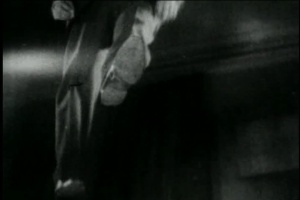
In 1926, Alfred Hitchcock directed Ivor Novello in The Lodger, a gripping thriller about a serial killer loose in London. One notable scene has Novello pacing back and forth in his room while the family with whom he is lodging listen in the room below, convinced he is the twisted killer. How on earth do you communicate the sound of someone pacing if you can’t hear it? You do what Hitchcock did and film Novello pacing on sheet glass, then superimpose it over the ceiling so it looks as though we can see through the ceiling to the room above. No sound required.
It is this inventive spirit that marks the silent filmmakers as true pioneers, and also a good source of inspiration for writers. Think about what you’re trying to communicate, and how you’re going to communicate it, and ask yourself… is there a more inventive way of doing so?
Check Your Pacing
Without dialogue to puncture the silence, early films couldn’t rely on lengthy speeches or conversations to pass the time. Films had to be short due to the technical capabilities of the equipment, but few viewers would sit through a film rife with pacing problems. D W Griffith’s Birth of a Nation ran at just over three hours long, but his tendency to focus on imagery for imagery’s sake left the film feeling tedious and self-indulgent. Writers can fall into the same trap, either by rattling off reams of purple prose, or by getting bogged down in dialogue and “witty” exchanges that soon become staid. A balance between the two should always be sought, and always ensure that your pacing remains even – try passing your work to a trusted reader, and if they find some passages too fast or slow, then double check to the balance between dialogue and prose.
Do you find that cinema principles can help enrich your writing?
Labels:
film studies,
silent cinema,
writing,
writing advice
Friday, 9 August 2013
#FridayFlash - Settling In
Tweet
The cabinet looked easy to assemble in the store, but Sadie stared at the instructions as though they were written in hieroglyphics. They might as well have been, for all of their nonsensical symbols and pictograms. She looked back down at the two panels she was trying to fix together and sighed.
Still, the furniture wouldn't put itself together, and they needed somewhere to house the TV. At least that way they'd have something to do on an evening, instead of staring at boxes, hoping they'd unpack themselves.
She leaned forward and began tightening the left screw. The wood moaned a complaint as the metal forced a spiral path within the pre-drilled hole. Sadie thrust her weight behind the screwdriver and twisted the handle.
A crash sounded behind her, and Sadie jolted forward. The screwdriver jumped out of the screw head and cut into the palm of her hand. Blood welled up along the thin line, and stinging pain enveloped her hold hand. Sadie swore under her breath, and turned around to see what made the crash. The room was empty aside from herself and the furniture. Something warm trickled down her palm, and Sadie looked back to her hand to see blood dripping from the wound onto the floor.
Sadie clambered to her feet and hurried into the kitchen. Two clean tea towels lay on the draining board. She wrapped one of them tightly around her hand to stop the bleeding, and carried the other back into the living room. She looked down at the floor in front of the half assembled cabinet and stopped.
The blood was gone.
"Sweetie? Did you clean the floor?" Sadie called into the dining room. Toby poked his head around the door, paint splattering his hair and T-shirt.
"No, why?"
"I cut my hand on a screwdriver and it bled onto the floor, only now it's gone."
"Are you ok?" Toby crossed the room and unwrapped her hand to inspect the injury. Blood oozed out of the cut and onto the towel.
"I'll be fine, but the floor..."
Toby looked at the floor, and back at Sadie.
"It must have soaked in already," he said, giving her a wink as he suppressed a smile.
"Maybe it wasn't that bad," said Sadie. She looked around the room, still unsure what made the crash in the first place.
"Come on, let's get that hand cleaned up." Toby led her out of the room in search of their first aid box.
Somewhere in the dark depths, below the basement, the house licked its lips.
Labels:
creative writing,
flash fiction,
friday flash
Monday, 5 August 2013
[Film Review] The Conjuring
Tweet
Nearly every horror film that is released nowadays bills itself as "the scariest movie", either of all time, or that particular year. It's hardly surprising - after all, horror is one of the few genres that is focused on how they make the audience feel, as opposed to being clustered according to theme or iconography. The problem occurs because how scary a film is can be a difficult thing to judge - what terrifies me does not necessarily terrify you, and even if we're terrified by the same thing, there's no guarantee that we'll find it frightening when we see it on screen.
That being said, I do think The Conjuring can lay some sort of claim toward being one of the creepiest films of recent years. Director James Wan might be responsible for Saw, and thus the tedious succession of torture-porn-lite sequels, but having begun to explore the supernatural side of horror with Insidious in 2010, he now has a go at a period piece horror. The Conjuring is set in the 1970s, and based upon a true story surrounding Ed and Lorraine Warren, prominent ghost hunters and demonologists who also investigated the Amityville case. Patrick Wilson plays Ed, while Vera Farmiga plays Lorraine. Despite their scientific and methodical approach, the couple's brand of ghost busting relies heavily on their Catholic backgrounds, as well as upon Lorraine's clairvoyancy. This is not a film that wants to leave any ambiguity as to whether these things are real - as far as The Conjuring goes, this might as well be a documentary.
The Perron family buy a house in Rhode Island at auction, and promptly move in, excited by their spacious new home. This being a horror film, settling in is not destined to be easy, and after discovering a boarded-up basement, things start going wrong in the house. Carolyn, played by Lili Taylor, finds herself covered in mysterious bruises, while the five daughters are either pulled out of bed by an invisible force or speak to people that no one else can see. Carolyn realises something is afoot, and contacts the Warrens for their help. The couple investigate, and must tell the family the grim truth, that their house isn't haunted by a ghost, but rather an inhuman spirit. In order to qualify for an exorcism, evidence must be gathered, and the family must wait it out while the spirits do enough damage to persuade the authorities that this isn't just a pesky poltergeist.
Just as Paranormal Activity purported to be about ghosts but instead went with the demonic, so The Conjuring eschews ghostly goings on in favour of diabolical intervention. It essentially takes the worst parts of Poltergeist and combines them with The Exorcist, all while reminding you that this actually happened. It would be incredibly easy to dismiss it as cinematic fluff, but in all honesty, I found some of the scenes quite harrowing, not necessarily because of the phenomena depicted, but because I actually cared about the characters. I've done paranormal investigations myself and I've never been thrown across a room or seen mysterious figures in mirrors, but that doesn't mean I can't feel for a mother who's been locked in her own basement by someone she can't even see. I'm also uncomfortable with the insistence that all of this activity is the result of demons - naturally a belief in demons requires a belief in God - but I'll go with it for the sake of the film.
A lot of the reviews of the film keep picking flaws based on how 'true' the film is, but I think that's to miss the point. Even if the entire thing is made up, it doesn't follow that it'll be a bad film. Mary Shelley dreamed Frankenstein and it hasn't stopped the story from being a success, has it? James Wan has proven he can direct a film with little/no gore, and very few special effects, although the insertion of the Warrens' famous Annabelle case just seemed like an excuse to shoehorn yet another weird doll into one of his films. The performances all round help to make The Conjuring feel like a real family drama, as opposed to the usual melodrama that accompanies modern hauntings. It's not scary in the slightest, but it's downright creepy - and in my book, that's harder to manage.
5 blunt pencils out of 5
Labels:
cinema,
film review,
horror
Friday, 2 August 2013
#FridayFlash - The Flee Market
Tweet
Ground smog swirled around the feet of the traders as they set up their stalls. A clock chimed in the cavern of the marketplace to announce the early hour. Humans and trolls lurched back and forth, rubbing sleep from their eyes as they laid out their wares on grubby cloths.
Vyolet lurked in the shadows at the edge of the vault. The Flee Market was a tempting target for a Shadowkin, particularly at four in the morning. The so-called militia, little more than local thugs collecting protection money from the traders, wouldn't arrive until five, and the traders were too distracted by setting up to notice a disappearing bread roll or hunk of cheese. The militia would light the lamps, making shadows scarce, but until then, Vyolet could come and go as she pleased.
Vyolet stole through the shadows in the arches leading down to the docks. Ferrymen carried crates up the steps from the canals, and a gaggle of fishwives trudged along the narrow quay behind them. Vyolet peered into the baskets they carried on their hips, but their treasure didn't interest her. It was mostly worthless detritus fetched by their husbands from the Distant Sea.
She passed an alchemist's stall, and frowned. He wore a pin in the lapel of his threadbare frock coat, and the insignia was that of the local DWS group - Down With Shadowkin. Vyolet fought the urge to tear the pin from his coat as she passed, but instead, she filched a small bag of sleeping sand from his table while he looked the other way. Few in the Underground City had any love for the Shadowkin, but without their abilities, the spy network that kept the City Above at bay couldn't operate.
If it wasn't for rogues like me... Vyolet began the thought, but she couldn't finish it. What was the use in being a rogue when she was forced to steal food from the market between jobs? Still, the Flee Market was a den of opportunity. Named for its status as a haven for those fleeing justice, the vast square, with its vaulted roof and bright green lanterns, was Vyolet's favourite place in the city.
Vyolet spotted a disenchanter across the aisle, and flattened herself against the wall beside his table. The shadow was narrow here, and she barely managed to squeeze herself into the blackened rectangle. She watched him remove the enchantments from cheap tourist wares, separating the imitation esoteric items from their magical sparks. The items ended up in a huge basket behind him, but the sparks went into neatly labelled bottles on the table. One of the items was a scarf, and Vyolet snagged it from the basket while the disenchanter busied himself with a wooden replica of the Abandoned Chapel. She tied it around her hair in the fashion of the worker women from the Trade District, but she knew her shifting skin colour and purple eyes would give her away as a Shadowkin.
Her stomach grumbled as Vyolet wandered among the stalls, sneaking from shadow to shadow, trying to spot a food stall. She passed stalls selling boots, fabric, magical equipment, broken furniture and even books, but no food. The clock chimed again to mark the quarter hour, and panic coloured Vyolet's hunger. She hadn't eaten since the day before, and she didn't have long before the militia arrived. They were all card carrying members of the DWS group, and would take great delight in ejecting her from the market - or worse, ejecting her soul from her body.
Vyolet passed under the vast clock, the only way to tell the time underground, and saw she had just five minutes until the militia arrived to patrol the market. She gazed across the sea of stalls and her heart leapt to see a baker reach his stall. He carried a large wicker basket on his back, while two goblins carried smaller ones behind him. She used the shadows between the cobbles of the floor to cross the open square in the centre of the market, and hid in the shadow cast by the awning of his stall. The goblins dumped their baskets and trudged off in the direction from which they had come, leaving the baker to set up alone.
Vyolet seized her chance and grabbed two fresh rolls while the baker laid out long plaited loaves. She got three yards away from the stall when a large hand landed on her shoulder. The chubby fingers forced her to turn around, and she looked up into the heavyset face of a militia runner. He wore the enchanted goggles that allowed him to see her, even in the shadows, and a lopsided leer that made her blood run cold.
"Thought you'd get away, did ya?" He leaned in towards her, and the smell of his breath turned her growling stomach.
Vyolet saw two more runners on the far side of the square. She twisted out of his grip and threw the rolls across the square, smacking two goblins in the back of the head. They turned on each other, and the runners busied themselves with breaking up the fight. Before the runner could raise the alarm, Vyolet dipped her hand into the pouch on her belt and withdrew a fistful of sleeping sand. She blew it into the runner's face, and melted into the shadow cast by his vast bulk as he fell to the ground.
Vyolet streaked across the market, dipping and weaving through the shadows cast by early shoppers. The distracted runners realised what had happened, and their shouts echoed between the stalls. She didn't dare stop to grab more food - escaping with her life seemed more important than her hunger.
She reached the docks and skipped across the canal in the shadows cast by the wall of the marketplace. As she fled into the sewers, she couldn't help thinking the market was well named after all.
Original image by Sankla1. Edits by me.
Tuesday, 30 July 2013
Announcement - New Book Coming!
Tweet
I think anyone who knows me knows that I have a bit of a thing about mummies. You can keep your vampires and werewolves, if there's a bandaged critter lurking somewhere - I can't actually get away from them, either. If I go to a museum, I'll always end up finding the mummies. I love them! I've posted a fair few mummy stories as part of my Friday Flash activity over the past few years, and now I'm pleased to say that I've managed to place a novella featuring mummies with a publisher!
The Necromancer's Apprentice is my retelling of the fabled Sorceror's Apprentice, only it replaces the sorceror with a necromancer, and the overly helpful brooms with blood-lusting mummies. It also features dog-headed men, a fight scene involving a scythe, and a pterodactyl. It's partly set in the Underground City which has appeared in a few of my Friday Flashes (click here if you want another look) and partly in the City Above, where the hapless apprentice ends up working in the House of the Long Dead. I'm not overly sure if it's horror, or dark fantasy, but I'm pitching it as somewhere between the two.
I'm really excited to announce that Dark Continents Publishing, who also published Nerine Dorman's Inkarna and Rab Swannock Fulton's Transformation, will be putting out The Necromancer's Apprentice through their Darkness and Dismay division. My ace new editor, Nerine Dorman, reckons I'm the twisted version of JK Rowling. I'll leave it up to you to decide if you agree when it comes out!
In the meantime, expect more Underground City stories, and definitely more mummies...
Friday, 26 July 2013
#FridayFlash - Broken Windows
Tweet
When we used to watch the apocalypse on TV, we always saw people finding shelter. Old schools, houses, hospitals - anywhere you could lay your hat. Domesticity was restored in unlikely places - heck, plenty of post-apocalyptic shows had people living in houses beset by zombies, while their lawns always looked freshly mown. We all figured "if it ever happens, we'll be fine. Don't worry."
Then the apocalypse happened, like some of us always suspected it would. It wasn't fine - far from it. Sure, we found places to hide out, to get out of the punishing sun and away from the hundred-mile-an-hour gales that threw sand in your face. But we didn't think about the windows. When we went looking for new homes, we couldn't find buildings with glass intact. The walls kept out the sun, but the wind? You need windows to shelter from that.
So we did what we could. We boarded some windows up, or made makeshift shutters. Occasionally we'd duct tape the larger pieces of glass together, but some windows ended up more tape than glass. Mostly we used tarpaulins we hauled out of the vans that didn't run any more, or plastic sheeting we found in skips or abattoirs. Bin bags were especially useful, and they became a weird kind of currency as we hunkered down in our reclaimed homes, squatting in town halls and shopping centres, trying to reboot society with whatever we had to hand.
It's funny, we used to watch the world through television screens. Now we watch it through plastic sheeting.
Original image by beermug. Edits by me.
Labels:
creative writing,
flash fiction,
friday flash