Tweet
No matter how good your intentions, sticking to a well-honed writing routine over Christmas is virtually impossible. Putting aside all of the time commitments involved in buying and wrapping presents, visiting friends and family, and preparing all that food, even if you do manage to sneak in some writing time, you’ll no doubt be met with cries of “Oh you’re not writing, are you? But it’s Christmas.”
Writers are lucky in that their chosen line of work is not only fun, it also offers a high degree of escapism, but sadly, many non-writers still think we’re chained to our laptops. Of course, the problem you face after any interruption to a routine is finding a way back into it. Christmas offers a particularly large interruption due to the length of time it seems to last, and the fact that you’ll be trying to get back into other routines, not just those involving writing. Still, it must be done, so here are five suggestions of things you can do to get back into the swing of things!
Write ANYTHING for Ten Minutes
Yes, this one is fairly self-explanatory. Choose anything as a prompt, or just simply write about what you got for Christmas. It doesn’t matter what you’re writing, just make sure it’s constant for ten minutes. Don’t worry about what you’re writing, just write without pauses. Use a timer, or a website like Write or Die to keep you on track. It’s amazing how much simply writing to get the words out will get you back into the habit of writing.
Use a Current Project As a Prompt
If you’re in the middle of a longer project, try writing a flash or short story about a character other than the protagonist. If you don’t have something on the go, write about a character from a story you’ve already finished.
Use Movies to Inspire You
Chances are, you may have watched some great movies over the Christmas period. Write a missing scene, prologue or ending from a movie of your choice. Prose is fine, though if you want to write it in screenplay format that could keep you on your toes! It’s always beneficial to try writing in a different form to the one you’re used to.
Revisit Old Ideas
If you keep a notebook (and you should), flick through and browse those ideas you’ve jotted down in the past years. If none of them strike you as being good fodder for a flash, short story or even a novel, then choose a sentence at random and those that as a prompt for a story, poem or even a blog post.
Let the World Inspire You
Re-read something you’ve actually finished. Remember why you wrote it, and how much you enjoyed finishing it. Go for a walk and let your brain absorb everything around you – you might even do this just before you go out to check out the sales. Get back to your writing area feeling refreshed and ready to write!
Make sure you make a concerted effort to get back into your writing routine, but don’t push yourself too hard or your brain will rebel against you. Try one (or all, if you’re feeling brave) of these suggestions and see how it goes. We're two weeks into 2014 and it would be a good way to establish a routine for the coming year if you got back into one now!
Showing posts with label writing advice. Show all posts
Monday, 13 January 2014
Thursday, 15 August 2013
Silent Cinema Will Make You A Better Writer
Tweet
I wrote this post back in January 2012 for Fuel Your Writing but the more I've been watching silent cinema for my PhD, the more I think the principles are still applicable. I first wrote the post following the phenomenal success of The Artist, a modern day silent film set in the late 1920s, although I've now expanded it to include a few other films. I’m a firm believer in applying film theories or techniques to writing, and it seemed an ideal time to examine five principles of silent cinema that can enrich the work of a writer.
Why would I do that? I know some might say that film and literature are separate disciplines and naturally have different requirements (for example, an establishing shot is essentially in film, but if a writer takes too long to ’set the scene’, it can make for very dull reading) but I’d argue that writers can still learn new things from different sources. Writers shouldn’t fall into the trap of assuming that only studying writing can help their work. I’m not saying that you should cut all dialogue from your work, but let’s have a look at the bigger picture…
1) Show, Don’t Tell
This is probably the king of all silent cinema techniques that the writer should use, and is arguably advice you’ve heard before. Without dialogue, the actors have to display every emotion either on their face, or through their body language. It is indeed true that a picture tells a thousand words, and we don’t need reams of exposition when faced with a faltering smile or a pouting femme fatale with her arms tightly folded across her chest. We don't need someone to tell us that Dr Caligari is a nutjob when he's depicted with a crazed stance, a wild facial expression and melodramatic gesticulations - we can see it for ourselves. Show us what’s going on with your characters, let their facial expressions and body language do the talking. We’re aware of it all the time in real life, so why not try it in your writing?
2) No Info Dumps!
It’s an attractive tendency of fiction to allow your characters to dole out back story through so-called ‘info dumps’, usually within lengthy passages of dialogue. The brevity of the silent film cue card doesn’t allow for masses of text, so key visuals are chosen instead to fill in the back story. Just as film fans were trusted to be able to understand the implications of specific shots, trust your readers to pick up on the small details and fill in the rest themselves. For example, you don’t need to waste paragraphs describing a character’s reliance on alcohol – just show them putting yet another empty bottle into a crate full of other empty bottles.
Do You Really Need Back Story?
If you’ve seen The Artist, you’ll realise that neither George Valentin nor Peppy Miller have in depth backstories. George is a successful silent film star and Peppy is a girl who comes to Hollywood looking for fame. We never learn much more than that, but nor do we need to. The performances and actions of both characters make it easy to like them and root for them, without time needing to be taken to explain how past events have coloured or shaped their present decision-making. Charlie Chaplin gave his Little Tramp very little backstory because the films were set in the 'here and now' - we didn't need to know what he did for a living before working in the factory in Modern Times because it's irrelevant. I know writers are counselled to know the entire biographies of their characters but you don’t have to communicate that to the reader – just pertinent details so we understand why they’re doing what they’re doing.
Be Inventive
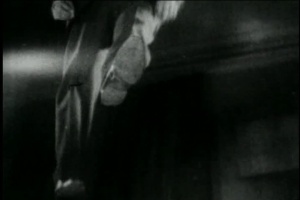
In 1926, Alfred Hitchcock directed Ivor Novello in The Lodger, a gripping thriller about a serial killer loose in London. One notable scene has Novello pacing back and forth in his room while the family with whom he is lodging listen in the room below, convinced he is the twisted killer. How on earth do you communicate the sound of someone pacing if you can’t hear it? You do what Hitchcock did and film Novello pacing on sheet glass, then superimpose it over the ceiling so it looks as though we can see through the ceiling to the room above. No sound required.
It is this inventive spirit that marks the silent filmmakers as true pioneers, and also a good source of inspiration for writers. Think about what you’re trying to communicate, and how you’re going to communicate it, and ask yourself… is there a more inventive way of doing so?
Check Your Pacing
Without dialogue to puncture the silence, early films couldn’t rely on lengthy speeches or conversations to pass the time. Films had to be short due to the technical capabilities of the equipment, but few viewers would sit through a film rife with pacing problems. D W Griffith’s Birth of a Nation ran at just over three hours long, but his tendency to focus on imagery for imagery’s sake left the film feeling tedious and self-indulgent. Writers can fall into the same trap, either by rattling off reams of purple prose, or by getting bogged down in dialogue and “witty” exchanges that soon become staid. A balance between the two should always be sought, and always ensure that your pacing remains even – try passing your work to a trusted reader, and if they find some passages too fast or slow, then double check to the balance between dialogue and prose.
Do you find that cinema principles can help enrich your writing?
![]() |
| Image from The Cabinet of Dr Caligari (1920) Courtesy of Wikimedia Commons |
Why would I do that? I know some might say that film and literature are separate disciplines and naturally have different requirements (for example, an establishing shot is essentially in film, but if a writer takes too long to ’set the scene’, it can make for very dull reading) but I’d argue that writers can still learn new things from different sources. Writers shouldn’t fall into the trap of assuming that only studying writing can help their work. I’m not saying that you should cut all dialogue from your work, but let’s have a look at the bigger picture…
1) Show, Don’t Tell
This is probably the king of all silent cinema techniques that the writer should use, and is arguably advice you’ve heard before. Without dialogue, the actors have to display every emotion either on their face, or through their body language. It is indeed true that a picture tells a thousand words, and we don’t need reams of exposition when faced with a faltering smile or a pouting femme fatale with her arms tightly folded across her chest. We don't need someone to tell us that Dr Caligari is a nutjob when he's depicted with a crazed stance, a wild facial expression and melodramatic gesticulations - we can see it for ourselves. Show us what’s going on with your characters, let their facial expressions and body language do the talking. We’re aware of it all the time in real life, so why not try it in your writing?
2) No Info Dumps!
It’s an attractive tendency of fiction to allow your characters to dole out back story through so-called ‘info dumps’, usually within lengthy passages of dialogue. The brevity of the silent film cue card doesn’t allow for masses of text, so key visuals are chosen instead to fill in the back story. Just as film fans were trusted to be able to understand the implications of specific shots, trust your readers to pick up on the small details and fill in the rest themselves. For example, you don’t need to waste paragraphs describing a character’s reliance on alcohol – just show them putting yet another empty bottle into a crate full of other empty bottles.
Do You Really Need Back Story?
If you’ve seen The Artist, you’ll realise that neither George Valentin nor Peppy Miller have in depth backstories. George is a successful silent film star and Peppy is a girl who comes to Hollywood looking for fame. We never learn much more than that, but nor do we need to. The performances and actions of both characters make it easy to like them and root for them, without time needing to be taken to explain how past events have coloured or shaped their present decision-making. Charlie Chaplin gave his Little Tramp very little backstory because the films were set in the 'here and now' - we didn't need to know what he did for a living before working in the factory in Modern Times because it's irrelevant. I know writers are counselled to know the entire biographies of their characters but you don’t have to communicate that to the reader – just pertinent details so we understand why they’re doing what they’re doing.
![]() |
| Courtesy of The Hitchcock Project |
In 1926, Alfred Hitchcock directed Ivor Novello in The Lodger, a gripping thriller about a serial killer loose in London. One notable scene has Novello pacing back and forth in his room while the family with whom he is lodging listen in the room below, convinced he is the twisted killer. How on earth do you communicate the sound of someone pacing if you can’t hear it? You do what Hitchcock did and film Novello pacing on sheet glass, then superimpose it over the ceiling so it looks as though we can see through the ceiling to the room above. No sound required.
It is this inventive spirit that marks the silent filmmakers as true pioneers, and also a good source of inspiration for writers. Think about what you’re trying to communicate, and how you’re going to communicate it, and ask yourself… is there a more inventive way of doing so?
Check Your Pacing
Without dialogue to puncture the silence, early films couldn’t rely on lengthy speeches or conversations to pass the time. Films had to be short due to the technical capabilities of the equipment, but few viewers would sit through a film rife with pacing problems. D W Griffith’s Birth of a Nation ran at just over three hours long, but his tendency to focus on imagery for imagery’s sake left the film feeling tedious and self-indulgent. Writers can fall into the same trap, either by rattling off reams of purple prose, or by getting bogged down in dialogue and “witty” exchanges that soon become staid. A balance between the two should always be sought, and always ensure that your pacing remains even – try passing your work to a trusted reader, and if they find some passages too fast or slow, then double check to the balance between dialogue and prose.
Do you find that cinema principles can help enrich your writing?
Labels:
film studies,
silent cinema,
writing,
writing advice
Tuesday, 28 May 2013
How to Write Something New
Tweet
There would appear to be three major 'versus' debates going on in publishing these days. You've got Self-publishing versus Traditional Models, there's Work for Free versus Alternate Income Stream, and Pants versus Plotting. I'm not going into the first two, but the third is one with which I've wrestled for some time.
The key pros and cons of Pants versus Plotting are quite straightforward. Writing by the seat of your pants lets you enjoy the creative process, going where the story takes you, and essentially 'making it up as you go along', but you can end up with dozens of dead ends, characters you don't even need, or endings that just flat out don't work because they don't make sense when compared to the beginning.
By contrast, plotting allows you to map out the work before you start, so you never sit down to write without knowing where the story is going, and you can work out story kinks before you even finish the book/story - it's much easier to rearrange elements in an outline than it is in the finished piece. Unfortunately, it can feel restrictive, and remove some of the 'surprises' that pop up when you're pantsing.
For most of my works, I've used a combination of the two. I've known the major points of the beginning, middle and end, and my writing process has been simply joining the dots, making it up as I go along to get from A to B. It lets me keep an ending in mind, but gives me enough freedom to give my imagination room to gambol about.
I came across Story Engineering by Larry Brooks and while it's a fascinating book with a lot going for it, I got sucked into the mindset of "You must outline to the very last detail", and it completely derailed my creativity. I wrote The Necromancer's Apprentice using his method, but I only started to enjoy it when I'd finished my first draft, and went back to insert scenes that I felt would give the story life. I've got another novella I want to write, and I've fully outlined it, but I find I can't start it - weirdly enough, I know what needs to happen where, but I don't know where to start, and I have that ever present worry that I can't do the outline justice.
A while ago, I wrote a post on The Magic of 500, and I decided to revisit it to see if it would help. For a long time, I've been using the 750words.com website, and I suddenly realised that while I've thought I don't have much time to write, I've been putting in 15-20 minutes every day to write 750 words of crap. I worked out that by writing 750 words a day, a 30k word novella could be written in just forty days. So I could use those twenty minutes to do something productive, leaving my longer bouts of time free to edit The Necromancer's Apprentice. Interesting...
I wrote a Friday flash a couple of weeks ago called Contagion, and I had a few calls to turn it into a novella. I dashed out an idea for the beginning, middle and end, and just started writing. Earlier today it passed the 6.5k mark. It's going to need a lot of editing but the important thing is that I'm writing again. Aside from Friday flashes, I haven't written anything new in a long time.
So long may it continue...
There would appear to be three major 'versus' debates going on in publishing these days. You've got Self-publishing versus Traditional Models, there's Work for Free versus Alternate Income Stream, and Pants versus Plotting. I'm not going into the first two, but the third is one with which I've wrestled for some time.
The key pros and cons of Pants versus Plotting are quite straightforward. Writing by the seat of your pants lets you enjoy the creative process, going where the story takes you, and essentially 'making it up as you go along', but you can end up with dozens of dead ends, characters you don't even need, or endings that just flat out don't work because they don't make sense when compared to the beginning.
By contrast, plotting allows you to map out the work before you start, so you never sit down to write without knowing where the story is going, and you can work out story kinks before you even finish the book/story - it's much easier to rearrange elements in an outline than it is in the finished piece. Unfortunately, it can feel restrictive, and remove some of the 'surprises' that pop up when you're pantsing.
For most of my works, I've used a combination of the two. I've known the major points of the beginning, middle and end, and my writing process has been simply joining the dots, making it up as I go along to get from A to B. It lets me keep an ending in mind, but gives me enough freedom to give my imagination room to gambol about.
I came across Story Engineering by Larry Brooks and while it's a fascinating book with a lot going for it, I got sucked into the mindset of "You must outline to the very last detail", and it completely derailed my creativity. I wrote The Necromancer's Apprentice using his method, but I only started to enjoy it when I'd finished my first draft, and went back to insert scenes that I felt would give the story life. I've got another novella I want to write, and I've fully outlined it, but I find I can't start it - weirdly enough, I know what needs to happen where, but I don't know where to start, and I have that ever present worry that I can't do the outline justice.
A while ago, I wrote a post on The Magic of 500, and I decided to revisit it to see if it would help. For a long time, I've been using the 750words.com website, and I suddenly realised that while I've thought I don't have much time to write, I've been putting in 15-20 minutes every day to write 750 words of crap. I worked out that by writing 750 words a day, a 30k word novella could be written in just forty days. So I could use those twenty minutes to do something productive, leaving my longer bouts of time free to edit The Necromancer's Apprentice. Interesting...
I wrote a Friday flash a couple of weeks ago called Contagion, and I had a few calls to turn it into a novella. I dashed out an idea for the beginning, middle and end, and just started writing. Earlier today it passed the 6.5k mark. It's going to need a lot of editing but the important thing is that I'm writing again. Aside from Friday flashes, I haven't written anything new in a long time.
So long may it continue...
Labels:
750 words,
how i write,
writing advice,
writing process
Wednesday, 30 January 2013
What writers can take from Django Unchained
Tweet
I finally got to see Django Unchained at the weekend, a film I'd been looking forward to for a long time since a) I love Westerns, b) I like Tarantino and c) I love Leo DiCaprio. My review is over on my film blog, but I had a few thoughts about what writers could take away from the movie.
1) Do your research.
The world of Django Unchained felt very plausible, and very real. At no point did I look at anything and think it was anachronistic, although while checking things for this post, I discovered that Tarantino has included dynamite some eight years before it was invented. Still, fiction is allowed to take some liberties, as long as they're within the bounds of possibility. The costumes were fabulous, the set design had a real attention to detail that period pieces always need, and Tarantino had clearly researched the social situation of 1858. No matter whether you're setting your story in 2087 or 1887, it needs to feel real to a reader. Even futuristic pieces need research to extrapolate the likelihood of possible inventions becoming reality.
2) Don't be afraid of controversy.
Don't feel you have to court controversy - for every person who reads your work out of genuine interest, you'll have another who reads it for its reputation, and that's a Pandora's box you don't want to open as you scrabble to top each controversial outing. Having said that, don't shy away from a topic because you feel it is, or might be, controversial. Fiction will always need brave authors willing to talk about things that no one else will discuss, and if you have an original, fair, or unique take on a subject, why not try it out? Tarantino certainly did. Whether he was right or wrong to do tackle the subject of slavery using the generic conventions of both the Western and the Revenge film so is not for me to decide, but kudos to him for having the balls to raise the topic in the first place.
3) Know when to end a scene.
There were more than a few scenes where I found myself mentally screaming "CUT! FOR THE LOVE OF ALL THAT IS HOLY, CUUUUUUT!" Tarantino's often had the tendency to ramble, letting scenes go on far longer than they need to, while the additional running time does nothing to further the story (although it may increase your need to duck out to the bathroom). As a reader, if you feel that a scene is going on too long you might just skip to the next one - or worse, you might put the book down altogether. Writers need to know when to stop a scene, or cut it entirely. If it doesn't further the plot or illuminate something important, lose it. If it feels like it's running out of steam, cut and get on with it.
4) Using up your big finish too early.
It wasn't one of his biggest hits but Death Proof got it just right when the climactic set piece, that epic car chase, was at the very end of the film. Likewise the fight sequence between the Bride and O-Ren Ishii in Kill Bill Pt I. Trouble is, I felt like Django Unchained's big shoot-out was the big set piece, as opposed to the actual climactic ending...meaning that the film after said shoot-out sagged a little. That would be like Luke destroying the Death Star and spending another forty five minutes wandering around. Keep your big finish for the end.
5) Give your hero flaws...but don't make him easy to dislike.
I think my biggest problem with Django Unchained is that I warmed to King Schultz very easily, and I really liked the character, but I found it nigh on impossible to root for Django himself. If your sole presented reason for me rooting for someone is how badly they've been treated by someone else then you're not exactly presenting a rounded character. Likewise, making the guy a natural shot so he's a better gunslinger than Wyatt Earp without any practice just makes me too incredulous. His motivations were understandable, and possibly even commendable, but as a character, I just didn't like Django. I know that, in places, Django himself was playing a character in order to further his own ends, but it didn't feel like Django was stretching himself too much to play a bastard. Schultz had flaws, but they were there to make him human. By contrast, Django's flaws just made him into a cartoon character. So by all means give your protagonist flaws - after all, we don't want yet another Mary Sue - but don't make them unlikeable in the process. Even anti-heroes like Snake Plisskin are likeable.
What do you think?
1) Do your research.
The world of Django Unchained felt very plausible, and very real. At no point did I look at anything and think it was anachronistic, although while checking things for this post, I discovered that Tarantino has included dynamite some eight years before it was invented. Still, fiction is allowed to take some liberties, as long as they're within the bounds of possibility. The costumes were fabulous, the set design had a real attention to detail that period pieces always need, and Tarantino had clearly researched the social situation of 1858. No matter whether you're setting your story in 2087 or 1887, it needs to feel real to a reader. Even futuristic pieces need research to extrapolate the likelihood of possible inventions becoming reality.
2) Don't be afraid of controversy.
Don't feel you have to court controversy - for every person who reads your work out of genuine interest, you'll have another who reads it for its reputation, and that's a Pandora's box you don't want to open as you scrabble to top each controversial outing. Having said that, don't shy away from a topic because you feel it is, or might be, controversial. Fiction will always need brave authors willing to talk about things that no one else will discuss, and if you have an original, fair, or unique take on a subject, why not try it out? Tarantino certainly did. Whether he was right or wrong to do tackle the subject of slavery using the generic conventions of both the Western and the Revenge film so is not for me to decide, but kudos to him for having the balls to raise the topic in the first place.
3) Know when to end a scene.
There were more than a few scenes where I found myself mentally screaming "CUT! FOR THE LOVE OF ALL THAT IS HOLY, CUUUUUUT!" Tarantino's often had the tendency to ramble, letting scenes go on far longer than they need to, while the additional running time does nothing to further the story (although it may increase your need to duck out to the bathroom). As a reader, if you feel that a scene is going on too long you might just skip to the next one - or worse, you might put the book down altogether. Writers need to know when to stop a scene, or cut it entirely. If it doesn't further the plot or illuminate something important, lose it. If it feels like it's running out of steam, cut and get on with it.
4) Using up your big finish too early.
It wasn't one of his biggest hits but Death Proof got it just right when the climactic set piece, that epic car chase, was at the very end of the film. Likewise the fight sequence between the Bride and O-Ren Ishii in Kill Bill Pt I. Trouble is, I felt like Django Unchained's big shoot-out was the big set piece, as opposed to the actual climactic ending...meaning that the film after said shoot-out sagged a little. That would be like Luke destroying the Death Star and spending another forty five minutes wandering around. Keep your big finish for the end.
5) Give your hero flaws...but don't make him easy to dislike.
I think my biggest problem with Django Unchained is that I warmed to King Schultz very easily, and I really liked the character, but I found it nigh on impossible to root for Django himself. If your sole presented reason for me rooting for someone is how badly they've been treated by someone else then you're not exactly presenting a rounded character. Likewise, making the guy a natural shot so he's a better gunslinger than Wyatt Earp without any practice just makes me too incredulous. His motivations were understandable, and possibly even commendable, but as a character, I just didn't like Django. I know that, in places, Django himself was playing a character in order to further his own ends, but it didn't feel like Django was stretching himself too much to play a bastard. Schultz had flaws, but they were there to make him human. By contrast, Django's flaws just made him into a cartoon character. So by all means give your protagonist flaws - after all, we don't want yet another Mary Sue - but don't make them unlikeable in the process. Even anti-heroes like Snake Plisskin are likeable.
What do you think?
Labels:
becoming a writer,
cinema,
how to,
writing,
writing advice
Tuesday, 8 January 2013
Making Resolutions That Stick
Tweet
We're a week into the New Year, and if you’re a writer, you've no doubt composed a raft of New Year’s resolutions related to your craft - resolutions that you might find that you're struggling to stick to now that you're back into a routine at work and away from your 'holiday bubble'. While others resolved to visit the gym three times a week, or to buy fewer pairs of shoes, you’ve resolved to write 1000 words a day, finish writing eight novels, or to hit the best-seller list by the end of the year. We do it every year, and we usually fail every year, making us feel worse, not better, about our writing. So how can we make resolutions that we’ll be able to stick to?
1) Be realistic
One of the problems with resolutions is that we try to over-reach ourselves. Think of this not as a resolution but as a goal – so it’s what you’re aiming to do, not what you will do. By giving yourself this flexibility, you’re more likely to stick to whatever framework you set yourself, and therefore complete your goal by year’s end. So your phrasing might be “I intend to finish writing one novel of 70,000 words or more” as opposed to “I will write a trilogy of 100,000 word novels”.
2) Don’t try to change your habits overnight
Following on from number one, it’s no use telling yourself that you will write a 100,000 word novel by the end of April if you normally find you only have time to write around 3,000 words a week. If you push yourself to work beyond your time constraints or work patterns, you may find you drop behind within a few days, and soon you’ll lose the motivation to write at all. Keep your resolutions (or goals) within your usual habits and you’ll find it easier to keep going.
3) Your resolutions don’t have to be time dependent
We always think our resolutions have to run from January to December but that’s highly unrealistic – we have no way of knowing where we’ll be twelve months from now. So why not set quarter resolutions? Maybe you’ll set yourself a particular word count to hit between now and the end of March. If you hit it with ease, you can raise it for the end of June, and so on. If you can’t hit it, then you can always reduce your count for the next one until it’s manageable.
4) Think beyond the resolution
Try setting yourself an additional goal beyond the resolution itself – in psychological terms, link situations with actions. So you might reword your resolution from “I will finish my book and send it to an agent” to “If I complete my novel and receive positive beta feedback, then I will start sending it to agents”. It breaks the resolution down into manageable stages and gives you something to do when you've actually fulfilled the resolution. The end action also gives you an extra incentive.
5) Form a habit
Remember that you’re essentially trying to form a new habit by forming a resolution, and the only way for something to really become a habit is if you do it! Sit down, start typing, or researching – whatever it is you need to do to make your resolution a reality. The more regularly you do it, the better a chance you stand at actually making your resolution stick. Your resolution might be to write more, and you might have a spare ten minutes at lunch time, so maybe you might want to write 500 words every lunchtime. So get on and do it.
What are your resolutions - and have you broken them already?
1) Be realistic
One of the problems with resolutions is that we try to over-reach ourselves. Think of this not as a resolution but as a goal – so it’s what you’re aiming to do, not what you will do. By giving yourself this flexibility, you’re more likely to stick to whatever framework you set yourself, and therefore complete your goal by year’s end. So your phrasing might be “I intend to finish writing one novel of 70,000 words or more” as opposed to “I will write a trilogy of 100,000 word novels”.
2) Don’t try to change your habits overnight
Following on from number one, it’s no use telling yourself that you will write a 100,000 word novel by the end of April if you normally find you only have time to write around 3,000 words a week. If you push yourself to work beyond your time constraints or work patterns, you may find you drop behind within a few days, and soon you’ll lose the motivation to write at all. Keep your resolutions (or goals) within your usual habits and you’ll find it easier to keep going.
3) Your resolutions don’t have to be time dependent
We always think our resolutions have to run from January to December but that’s highly unrealistic – we have no way of knowing where we’ll be twelve months from now. So why not set quarter resolutions? Maybe you’ll set yourself a particular word count to hit between now and the end of March. If you hit it with ease, you can raise it for the end of June, and so on. If you can’t hit it, then you can always reduce your count for the next one until it’s manageable.
4) Think beyond the resolution
Try setting yourself an additional goal beyond the resolution itself – in psychological terms, link situations with actions. So you might reword your resolution from “I will finish my book and send it to an agent” to “If I complete my novel and receive positive beta feedback, then I will start sending it to agents”. It breaks the resolution down into manageable stages and gives you something to do when you've actually fulfilled the resolution. The end action also gives you an extra incentive.
5) Form a habit
Remember that you’re essentially trying to form a new habit by forming a resolution, and the only way for something to really become a habit is if you do it! Sit down, start typing, or researching – whatever it is you need to do to make your resolution a reality. The more regularly you do it, the better a chance you stand at actually making your resolution stick. Your resolution might be to write more, and you might have a spare ten minutes at lunch time, so maybe you might want to write 500 words every lunchtime. So get on and do it.
What are your resolutions - and have you broken them already?
Thursday, 6 September 2012
Lee Child's Writing Wisdom
Tweet
Last night, Lee Child made an appearance at the Tyneside Cinema to discuss his newest Jack Reacher book, A Wanted Man, and to introduce a screening of Se7en, his favourite film. I first heard about the Reacher books when my dad started reading them, and I bought the first one, Killing Floor, to read in Venice (it was that, or Fifty Shades of Grey). Despite its sometimes simplistic writing style, it's a compelling read, and I thoroughly enjoyed it.
I always like to take the chance to listen to other writers talking about writing, as it's always good to get another person's perspective on the process. Writing can be a solitary task, and sharing your working practices with others helps make it seem less lonely. So here are Lee Child's top tips as I can remember them, summarised in one handy blog post.
1) Avoid unnecessary words.
Lee made a point of discussing his obsession with Chuck Berry, in particular the song, Johnny B Goode. It's a whole story told in just over two minutes, but Lee pointed out the opening lines, in which we are told that among the evergreens close to New Orleans "There stood a log cabin made of earth and wood / Where lived a country boy named Johnny B. Goode". We know what log cabins are made of, so making a point of its method of construction is essentially a waste of time, and a waste of words. I think this explains the stripped down, minimalist style favoured by Lee for the Reacher books, but it's equally applicable to other genres - and also helps to back up my hatred of adverbs. Don't tell me someone "shouted loudly" - how many other ways are there to shout? Find a word that communicates your point and use it - don't use several phrases where one will do.
2) Treat writing as a job.
Lee described his process as being like the artisans making various products in Birmingham as he grew up. You can't sit and wait for the muse to appear and provide a story - you have to turn up every day and get your fingers moving on the keyboard. There will be days when you don't want to, but once you get into the habit, the muscle memory takes over and you'll write. As Lee pointed out, truck drivers don't get truck driving block, so why should writers get writer's block? Be an artisan, not an artist, and concentrate on producing a product. You can refine the product through editing once you've gotten the words on the page.
3) Ignore all advice.
Most writers give this as a piece of advice, and it's Lee's belief that if a writer simply writes from the heart, and writes the story they want to tell, then they'll get an organic, vivid story. If you want to write a story and then read advice by, say, Stephen King, you may feel you may not be able to write the story the way you want to. If you then read advice by JK Rowling, you might feel even more stuck. By writing things your way, the story will be more 'natural'. On one hand, I can relate to that because I felt somewhat hamstrung when I started reading books about plotting and certain writers insisted you outline a story down to the last full stop, but on the other hand, you need to know the rules before you can start breaking them. There's nothing wrong with learning about writing, but be aware that you might need to bend or break rules for your story to really work.
4) Always leave reviews.
Finally, one of the questions he was asked regarded the so-called 'sock-puppeting' scandal, and the practice of leaving reviews for books. Lee believes the only way for readers to really know what to buy is to read reviews, but the only way to drown out phony reviews is for readers to always post reviews, even if they're not favourable. I know I struggle to get reviews, but Lee reckons he gets one review for around 2000 sales - that's a lot of people reading who aren't reviewing. So do a writer a favour today, and review one of their books!
In case you're wondering, I did get a book signed, and I thought he was thoroughly charming!
I always like to take the chance to listen to other writers talking about writing, as it's always good to get another person's perspective on the process. Writing can be a solitary task, and sharing your working practices with others helps make it seem less lonely. So here are Lee Child's top tips as I can remember them, summarised in one handy blog post.
1) Avoid unnecessary words.
Lee made a point of discussing his obsession with Chuck Berry, in particular the song, Johnny B Goode. It's a whole story told in just over two minutes, but Lee pointed out the opening lines, in which we are told that among the evergreens close to New Orleans "There stood a log cabin made of earth and wood / Where lived a country boy named Johnny B. Goode". We know what log cabins are made of, so making a point of its method of construction is essentially a waste of time, and a waste of words. I think this explains the stripped down, minimalist style favoured by Lee for the Reacher books, but it's equally applicable to other genres - and also helps to back up my hatred of adverbs. Don't tell me someone "shouted loudly" - how many other ways are there to shout? Find a word that communicates your point and use it - don't use several phrases where one will do.
2) Treat writing as a job.
Lee described his process as being like the artisans making various products in Birmingham as he grew up. You can't sit and wait for the muse to appear and provide a story - you have to turn up every day and get your fingers moving on the keyboard. There will be days when you don't want to, but once you get into the habit, the muscle memory takes over and you'll write. As Lee pointed out, truck drivers don't get truck driving block, so why should writers get writer's block? Be an artisan, not an artist, and concentrate on producing a product. You can refine the product through editing once you've gotten the words on the page.
3) Ignore all advice.
Most writers give this as a piece of advice, and it's Lee's belief that if a writer simply writes from the heart, and writes the story they want to tell, then they'll get an organic, vivid story. If you want to write a story and then read advice by, say, Stephen King, you may feel you may not be able to write the story the way you want to. If you then read advice by JK Rowling, you might feel even more stuck. By writing things your way, the story will be more 'natural'. On one hand, I can relate to that because I felt somewhat hamstrung when I started reading books about plotting and certain writers insisted you outline a story down to the last full stop, but on the other hand, you need to know the rules before you can start breaking them. There's nothing wrong with learning about writing, but be aware that you might need to bend or break rules for your story to really work.
4) Always leave reviews.
Finally, one of the questions he was asked regarded the so-called 'sock-puppeting' scandal, and the practice of leaving reviews for books. Lee believes the only way for readers to really know what to buy is to read reviews, but the only way to drown out phony reviews is for readers to always post reviews, even if they're not favourable. I know I struggle to get reviews, but Lee reckons he gets one review for around 2000 sales - that's a lot of people reading who aren't reviewing. So do a writer a favour today, and review one of their books!
In case you're wondering, I did get a book signed, and I thought he was thoroughly charming!
Labels:
lee child,
writing advice,
writing tips
Wednesday, 15 August 2012
[Guest Post] Carrie Clevenger on Blog Serials
Tweet
At the start of August, you might have seen me madly tweeting about the fact I finally had a paperback copy of Crooked Fang by my very good friend Carrie Clevenger. Now, I'm not one for vampires, but I've been rather keen on Carrie's take since I first read the serial she ran on her blog. Times change and Xan Marcelles has taken his turn in the spotlight, and that very awesome serial is now a book. A proper, honest-to-God book I can (and do) wave in people's faces. Carrie's doing a blog tour to promote it, and here she is, talking about how to turn a blog serial into a book.
Over to you Carrie!
Xan Marcelles in Crooked Fang began life as a concept that’d occurred to me years before in some pitiful ninety-page story I wrote in a frenzy to purge my grief. I put Xan aside at that time because I wrote a different sort of vampire, much closer to Anne Rice’s style. Things happened. Time passed. Xan played a secondary character to the ancient vampire I was so enamored with, yet his own story scratched at the base of my brain.
I started a blog (that no longer exists) for fun in order to capture some of his story in 2008. I wrote posts whenever I felt like it and they were somewhat dark; how he lived, died, and came back as a vampire. Then I started a new blog called simply Crooked Fang. Crooked Fang is the name of Xan Marcelles’ band and it seemed catchy enough, very rock star in nature. In that blog, I wrote Xan’s life at a tavern he settled at, called Pale Rider, after leaving the vampire lifestyle behind. About the same time, I had him on Twitter along with my own account and discovered the power of social networking. I still only posted whenever a story would occur to me, but I started to get readers. They followed the blog and commented on each post and encouraged me. Xan’s silly adventures seemed to draw in people from all sorts of backgrounds due to his ordinary dude character and I realized that I had something there that was more than just screwing around. He was finally telling the story trapped in those horrid ninety pages I wrote in 2001.
I started out with eight readers. Thirty followers on Twitter for him. Their encouragement compelled me to become more regular with the posts, upping them to once every two weeks, then finally one a week. When #TuesdaySerial came about on Twitter, I listed his posts every week. My readership grew slowly but steadily. I was asked, “When’s the novel coming out?” Novel? I thought. I can’t write a novel. That’s a whole lot of words. I don’t have time to write ninety-thousand words besides what would I write about? Crooked Fang was just for fun; it was a release from everyday life. I liked to entertain and Xan was easy to love.
At second glance, I was kind of writing a novel somewhat, because when I put all the blog posts together, it equaled about fifty-three thousand words. Wow, I thought. Well, if I could do that, surely I could up it to sixty-thousand? I had it in my mind to self-publish it and was rather attached to the idea until I ran across someone on a doom metal band’s forum named Nerine Dorman.
Nerine and I hit it off almost immediately, due to our shared passion for the music of Type O Negative. She also happened to be an editor for a publishing company, Lyrical Press. Her curiosity was piqued when I mentioned Crooked Fang. Somehow, I ended up showing her the story and she made editing suggestions. Eventually she managed to convince me to try to publish through a company rather than on my own.
But here’s what you came for: How a serial on a blog is turned into a novel. Short answer is: Lots and lots of work. The long answer is the same but by layering: Adding deeper description, character insight, additional scenes, time consistency (mine was completely hosed at first) and motivation for each and every movement in the story. Eight versions of Crooked Fang reside on my hard drive because of the revision and editing process. Each time, I added a layer, trimmed a scene that didn’t fit, or changed a character and learned in general how to pace the story.
It’s a hands-on training sort of position when you take a rough draft and polish it to a finished novel and you gain a deep respect for those who’ve gone before you, especially for the more-epic-style writers. It is a huge investment perhaps not financially, but certainly lifestyle and time-wise.
I was stumped when it came time to end the novel. How to close off the plot in Crooked Fang after I resolved the main obstacle without fully resolving everything about Xan? Because when you resolve all of the character’s issues, the story is over. I left off and sent the story to Nerine, explaining that I still hadn’t thought of a proper ending. Turns out, the ending I just left off on was the final result.
Because a story never ends really, just like real life. I suppose one day Xan can ride off on some dark highway for the last time but for now, he’s not done. Neither am I. So how does Crooked Fang end? You’ll have to read the book to find out.
Sometimes a vampire's past can bite him in the ass.
Xan Marcelles--bassist for Crooked Fang, vampire and full-time asshole, is content with his quiet existence in the backwoods of Pinecliffe, Colorado. But life at the Pale Rider tavern is set to become a little more complicated when he gets entangled with a feisty, blue-haired damsel and her abusive soon-to-be ex boyfriend.
To add to his woes, he's gone from hunter to hunted, and his past returns to haunt him when a phone call draws him back to New Mexico. With the help of friends from his living past, he must get to the bottom of a murder, and figure out where he stands with his lover and his band, all while keeping one step ahead of his enemies. Hiding won't be easy for him, especially with a mysterious woman dogging him every step of the way.
WARNING: Cussing, smoking, drinking and hot sex.
Main site: crookedfang.com and sales link is here.
Lyrical Press, ebook format (all formats) to be published August 20.
Katarr Kanticles also, print version released August 1.
Also on Goodreads and Facebook.
Carrie Clevenger landed in the urban fantasy genre when she couldn't decide between horror and humor. When not writing she enjoys listening to music, hanging out with musicians, attending local venues, catching her favorite bands on tour, and obsessing over The Next Big Album release. Main influences include Maynard James Keenan, Stephen King, Anne Rice, and the late Peter Steele. Follow Carrie on Twitter as @CarrieClevenger.
Over to you Carrie!
* * *
Xan Marcelles in Crooked Fang began life as a concept that’d occurred to me years before in some pitiful ninety-page story I wrote in a frenzy to purge my grief. I put Xan aside at that time because I wrote a different sort of vampire, much closer to Anne Rice’s style. Things happened. Time passed. Xan played a secondary character to the ancient vampire I was so enamored with, yet his own story scratched at the base of my brain.
I started a blog (that no longer exists) for fun in order to capture some of his story in 2008. I wrote posts whenever I felt like it and they were somewhat dark; how he lived, died, and came back as a vampire. Then I started a new blog called simply Crooked Fang. Crooked Fang is the name of Xan Marcelles’ band and it seemed catchy enough, very rock star in nature. In that blog, I wrote Xan’s life at a tavern he settled at, called Pale Rider, after leaving the vampire lifestyle behind. About the same time, I had him on Twitter along with my own account and discovered the power of social networking. I still only posted whenever a story would occur to me, but I started to get readers. They followed the blog and commented on each post and encouraged me. Xan’s silly adventures seemed to draw in people from all sorts of backgrounds due to his ordinary dude character and I realized that I had something there that was more than just screwing around. He was finally telling the story trapped in those horrid ninety pages I wrote in 2001.
I started out with eight readers. Thirty followers on Twitter for him. Their encouragement compelled me to become more regular with the posts, upping them to once every two weeks, then finally one a week. When #TuesdaySerial came about on Twitter, I listed his posts every week. My readership grew slowly but steadily. I was asked, “When’s the novel coming out?” Novel? I thought. I can’t write a novel. That’s a whole lot of words. I don’t have time to write ninety-thousand words besides what would I write about? Crooked Fang was just for fun; it was a release from everyday life. I liked to entertain and Xan was easy to love.
At second glance, I was kind of writing a novel somewhat, because when I put all the blog posts together, it equaled about fifty-three thousand words. Wow, I thought. Well, if I could do that, surely I could up it to sixty-thousand? I had it in my mind to self-publish it and was rather attached to the idea until I ran across someone on a doom metal band’s forum named Nerine Dorman.
Nerine and I hit it off almost immediately, due to our shared passion for the music of Type O Negative. She also happened to be an editor for a publishing company, Lyrical Press. Her curiosity was piqued when I mentioned Crooked Fang. Somehow, I ended up showing her the story and she made editing suggestions. Eventually she managed to convince me to try to publish through a company rather than on my own.
But here’s what you came for: How a serial on a blog is turned into a novel. Short answer is: Lots and lots of work. The long answer is the same but by layering: Adding deeper description, character insight, additional scenes, time consistency (mine was completely hosed at first) and motivation for each and every movement in the story. Eight versions of Crooked Fang reside on my hard drive because of the revision and editing process. Each time, I added a layer, trimmed a scene that didn’t fit, or changed a character and learned in general how to pace the story.
It’s a hands-on training sort of position when you take a rough draft and polish it to a finished novel and you gain a deep respect for those who’ve gone before you, especially for the more-epic-style writers. It is a huge investment perhaps not financially, but certainly lifestyle and time-wise.
I was stumped when it came time to end the novel. How to close off the plot in Crooked Fang after I resolved the main obstacle without fully resolving everything about Xan? Because when you resolve all of the character’s issues, the story is over. I left off and sent the story to Nerine, explaining that I still hadn’t thought of a proper ending. Turns out, the ending I just left off on was the final result.
Because a story never ends really, just like real life. I suppose one day Xan can ride off on some dark highway for the last time but for now, he’s not done. Neither am I. So how does Crooked Fang end? You’ll have to read the book to find out.
Sometimes a vampire's past can bite him in the ass.
Xan Marcelles--bassist for Crooked Fang, vampire and full-time asshole, is content with his quiet existence in the backwoods of Pinecliffe, Colorado. But life at the Pale Rider tavern is set to become a little more complicated when he gets entangled with a feisty, blue-haired damsel and her abusive soon-to-be ex boyfriend.
To add to his woes, he's gone from hunter to hunted, and his past returns to haunt him when a phone call draws him back to New Mexico. With the help of friends from his living past, he must get to the bottom of a murder, and figure out where he stands with his lover and his band, all while keeping one step ahead of his enemies. Hiding won't be easy for him, especially with a mysterious woman dogging him every step of the way.
WARNING: Cussing, smoking, drinking and hot sex.
Main site: crookedfang.com and sales link is here.
Lyrical Press, ebook format (all formats) to be published August 20.
Katarr Kanticles also, print version released August 1.
Also on Goodreads and Facebook.
Carrie Clevenger landed in the urban fantasy genre when she couldn't decide between horror and humor. When not writing she enjoys listening to music, hanging out with musicians, attending local venues, catching her favorite bands on tour, and obsessing over The Next Big Album release. Main influences include Maynard James Keenan, Stephen King, Anne Rice, and the late Peter Steele. Follow Carrie on Twitter as @CarrieClevenger.
Tuesday, 15 November 2011
Story Structure - Pulp
Tweet
If you follow me on Twitter, among the copious tweets about who I would hire to provide the voice for my supervillain car (John Hurt and Mark Strong are the front-runners thus far but I'm sure I could accommodate Nathan Fillion) or my constant pleas to Hollywood to just GIVE THE SHAKY CAM A BLOODY REST, then you might have noticed a recent "wobble" in my normally impeccable self confidence [sic].
I realised that if I'm not posting writing prompts or Friday flash stories, then the rest of my blog posts are either book reviews or "writing advice". Now, I'll be honest with you. I do suffer from crippling self-esteem problems. I do get rattled by negative reviews. I do tie myself up in knots over whether or not people will be entertained by what I've written. So when I tried to think about what to dispense in the way of writing advice, I suddenly thought "Hang on, who the hell are you to tell people how to write?" It really bothered me. I mean, it's not like I'm Stephen King, is it? Still, as various valued tweeters pointed out, I have put out two books on my own that received good reviews, and I had my beloved Guns of Retribution published by the ever-awesome Pulp Press, so while I may not be anyone special, perhaps I can share something I've learned along the way.
One of the things I have learned is that story structure is probably the single most important thing that you can master. Dialogue, character, theme - these are all vital to the success of your story, but without a strong structure in which to place them, it's all just dust in the wind, dude. Normally I would cite Larry Brooks' Story Engineering or James Scott Bell's Plot & Structure at this point - they're both excellent books and I highly recommend them both for really getting your head around why successful stories work, and how you can give your own stories a fighting chance. Yes, there is a reason that books that may seem to be badly-written, predictable or full of crap characters still succeed, and it all comes down to how the story unfolds.
The reason I said "normally" is because there are other ways. Bell reduces structure to three acts; the first act sets up the plot, introducing us to the protagonist, and establishing their world. Act two begins when some sort of defining incident occurs, pushing the protagonist forward. Bell describes this point as being a doorway of no return - something happens to prevent the protagonist from returning to their previous way of life. Act two is the main bulk of the action, but there's still the possibility they could walk away. Finally, we reach another propelling incident pushes them into act three, an incident which forces them to put into action any plans they've made, or do whatever it is they have to do. It's a solid structure, and it works. Brooks breaks it down even further into hooks, plot points, midpoints, and Lord knows what else - I won't sport with your intelligence by breaking it down further, but the book really does explain a lot.
But there is another way. In 1904, Lester Dent was born in Missouri. In 1929, he sold his first story to Top Notch magazine. He became a hugely successful pulp author throughout the 1930s and 40s, writing all but twenty of the 181 Doc Savage novels about an adventure character who attained near-superhero status. Dent's Master Fiction Plot, also known as the Lester Dent Formula, is often given as an alternative plot for pulp stories of around 6000 stories. In it, Dent splits the plot into four, not the traditional three.
In the first quarter, we are introduced to the hero, along with his mystery (or whatever suits the genre). He has an initial attempt at sorting things out - and fails. Somewhere near the end of the first quarter, he ends up in trouble (usually physical conflict) and there is a twist in the plot. In the second quarter, more grief is heaped onto the hero - he struggles on, leading to another conflict, and another plot twist. The third quarter sees more grief for the hero, although he manages to make some kind of headway before he ends up in yet more conflict, and has to cope with another twist. The final quarter sees the hero really neck deep in the brown stuff, although he manages to free himself either through skill or strength. He heads off to solve the mystery and navigate the final plot twist.
Naturally that all seems a little formulaic but hey, he was writing pulp fiction. If you're interested, check the actual article out. The Master Plot is supposed to apply to 6000 word stories, but I used it when I wrote One Woman Cure for the forthcoming For Books' Sake anthology, Short Stack, and I even applied it (albeit loosely) to The Guns of Retribution. Why? Well, as much as The Guns of Retribution might be a Western, it is also a pulp Western, and as such subscribes to the conventions of the pulp genre (e.g. the femme fatale). I won't be using the pulp plot for the as-yet-unnamed sequel, but that's because I'm going down a supernatural route with this one, and I think that demands a more traditional structure. But I want to write more pulp in future, so I won't rule out using it again.
All I'm trying to say is that structure is important, but it's also something to be explored. Whether you use three acts, three acts and a crapload of points in between, or quartiles, find a structure that works for your story and stick to it. Your readers will thank you.
I realised that if I'm not posting writing prompts or Friday flash stories, then the rest of my blog posts are either book reviews or "writing advice". Now, I'll be honest with you. I do suffer from crippling self-esteem problems. I do get rattled by negative reviews. I do tie myself up in knots over whether or not people will be entertained by what I've written. So when I tried to think about what to dispense in the way of writing advice, I suddenly thought "Hang on, who the hell are you to tell people how to write?" It really bothered me. I mean, it's not like I'm Stephen King, is it? Still, as various valued tweeters pointed out, I have put out two books on my own that received good reviews, and I had my beloved Guns of Retribution published by the ever-awesome Pulp Press, so while I may not be anyone special, perhaps I can share something I've learned along the way.
One of the things I have learned is that story structure is probably the single most important thing that you can master. Dialogue, character, theme - these are all vital to the success of your story, but without a strong structure in which to place them, it's all just dust in the wind, dude. Normally I would cite Larry Brooks' Story Engineering or James Scott Bell's Plot & Structure at this point - they're both excellent books and I highly recommend them both for really getting your head around why successful stories work, and how you can give your own stories a fighting chance. Yes, there is a reason that books that may seem to be badly-written, predictable or full of crap characters still succeed, and it all comes down to how the story unfolds.
The reason I said "normally" is because there are other ways. Bell reduces structure to three acts; the first act sets up the plot, introducing us to the protagonist, and establishing their world. Act two begins when some sort of defining incident occurs, pushing the protagonist forward. Bell describes this point as being a doorway of no return - something happens to prevent the protagonist from returning to their previous way of life. Act two is the main bulk of the action, but there's still the possibility they could walk away. Finally, we reach another propelling incident pushes them into act three, an incident which forces them to put into action any plans they've made, or do whatever it is they have to do. It's a solid structure, and it works. Brooks breaks it down even further into hooks, plot points, midpoints, and Lord knows what else - I won't sport with your intelligence by breaking it down further, but the book really does explain a lot.
But there is another way. In 1904, Lester Dent was born in Missouri. In 1929, he sold his first story to Top Notch magazine. He became a hugely successful pulp author throughout the 1930s and 40s, writing all but twenty of the 181 Doc Savage novels about an adventure character who attained near-superhero status. Dent's Master Fiction Plot, also known as the Lester Dent Formula, is often given as an alternative plot for pulp stories of around 6000 stories. In it, Dent splits the plot into four, not the traditional three.
In the first quarter, we are introduced to the hero, along with his mystery (or whatever suits the genre). He has an initial attempt at sorting things out - and fails. Somewhere near the end of the first quarter, he ends up in trouble (usually physical conflict) and there is a twist in the plot. In the second quarter, more grief is heaped onto the hero - he struggles on, leading to another conflict, and another plot twist. The third quarter sees more grief for the hero, although he manages to make some kind of headway before he ends up in yet more conflict, and has to cope with another twist. The final quarter sees the hero really neck deep in the brown stuff, although he manages to free himself either through skill or strength. He heads off to solve the mystery and navigate the final plot twist.
Naturally that all seems a little formulaic but hey, he was writing pulp fiction. If you're interested, check the actual article out. The Master Plot is supposed to apply to 6000 word stories, but I used it when I wrote One Woman Cure for the forthcoming For Books' Sake anthology, Short Stack, and I even applied it (albeit loosely) to The Guns of Retribution. Why? Well, as much as The Guns of Retribution might be a Western, it is also a pulp Western, and as such subscribes to the conventions of the pulp genre (e.g. the femme fatale). I won't be using the pulp plot for the as-yet-unnamed sequel, but that's because I'm going down a supernatural route with this one, and I think that demands a more traditional structure. But I want to write more pulp in future, so I won't rule out using it again.
All I'm trying to say is that structure is important, but it's also something to be explored. Whether you use three acts, three acts and a crapload of points in between, or quartiles, find a structure that works for your story and stick to it. Your readers will thank you.
Labels:
pulp,
structure,
western,
writing advice


.jpg)