
Friday, 18 November 2011


Thursday, 17 November 2011
Public Domain Characters
Tweet
 I came across this rather fascinating post over on Fuel Your Writing about using public domain characters in your work. These are characters whose copyright has passed into the public domain, and are moreorless "up for grabs". Think of the novels of Jasper Fforde, or the retold fairytales that Gregory Maguire made popular (and whose novel, Wicked, spawned a musical). We couldn't have those endless literary remixes without them (though the jury is still out on whether or not that's a bad thing).
I understand the reasons for using them (built in audience, pre-existing mythology) as much as I understand the reasons for not using them (risk of upsetting existing fans, difficult to use them without it seeming gimmicky). Heck, I've even enjoyed reading them - I love the novels of Jasper Fforde, and I grudgingly admire what Alan Moore did with League of Extraordinary Gentlemen. I've only written such a story once - my Deathmatch escapade, in which I pitted Dracula against Edward Cullen. I did it for a giggle, but I'd never want to write a full-length novel using someone else's characters.
I've got two reasons, really. First of all, I know these characters are all well outside of their copyright and their creators are long gone. As much as I imagine Mr Darcy, Vampyre had Jane Austen spinning in her grave, realistically speaking, the author can't get cross about what I've done as they're not around to complain. Having said that, I'd be really uncomfortable with the idea of someone inserting Grey O'Donnell, Liss Hunt, Fowlis Westerby, or any of my other characters into their work. I guess it's a little possessive but my characters are either facets of myself, or characters who choose to work with me. So I guess I don't use other people's characters because I wouldn't want people to use mine.
But secondly, I like inventing my own characters. I can enjoy reading the stories of Dorian Gray, Dr Jekyll and Elizabeth Bennett, but they're not my characters. I can get to know them but I'll never know them inside out the same way that their creators do. So no matter what I might have these characters do, they'll only be refractions of the originals, viewed through my own particular matrix of experiences, prejudices and beliefs. With my own characters, I have all the fun of getting to know them, and even if I don't like them, at least I understand them. Besides, inventing backstory is one of the most entertaining things a writer can do (even if most of what they create never makes it into the book)
What about you? Would you use public domain characters in your work?

I understand the reasons for using them (built in audience, pre-existing mythology) as much as I understand the reasons for not using them (risk of upsetting existing fans, difficult to use them without it seeming gimmicky). Heck, I've even enjoyed reading them - I love the novels of Jasper Fforde, and I grudgingly admire what Alan Moore did with League of Extraordinary Gentlemen. I've only written such a story once - my Deathmatch escapade, in which I pitted Dracula against Edward Cullen. I did it for a giggle, but I'd never want to write a full-length novel using someone else's characters.
I've got two reasons, really. First of all, I know these characters are all well outside of their copyright and their creators are long gone. As much as I imagine Mr Darcy, Vampyre had Jane Austen spinning in her grave, realistically speaking, the author can't get cross about what I've done as they're not around to complain. Having said that, I'd be really uncomfortable with the idea of someone inserting Grey O'Donnell, Liss Hunt, Fowlis Westerby, or any of my other characters into their work. I guess it's a little possessive but my characters are either facets of myself, or characters who choose to work with me. So I guess I don't use other people's characters because I wouldn't want people to use mine.
But secondly, I like inventing my own characters. I can enjoy reading the stories of Dorian Gray, Dr Jekyll and Elizabeth Bennett, but they're not my characters. I can get to know them but I'll never know them inside out the same way that their creators do. So no matter what I might have these characters do, they'll only be refractions of the originals, viewed through my own particular matrix of experiences, prejudices and beliefs. With my own characters, I have all the fun of getting to know them, and even if I don't like them, at least I understand them. Besides, inventing backstory is one of the most entertaining things a writer can do (even if most of what they create never makes it into the book)
What about you? Would you use public domain characters in your work?
Tuesday, 15 November 2011
Story Structure - Pulp
Tweet
 If you follow me on Twitter, among the copious tweets about who I would hire to provide the voice for my supervillain car (John Hurt and Mark Strong are the front-runners thus far but I'm sure I could accommodate Nathan Fillion) or my constant pleas to Hollywood to just GIVE THE SHAKY CAM A BLOODY REST, then you might have noticed a recent "wobble" in my normally impeccable self confidence [sic].
I realised that if I'm not posting writing prompts or Friday flash stories, then the rest of my blog posts are either book reviews or "writing advice". Now, I'll be honest with you. I do suffer from crippling self-esteem problems. I do get rattled by negative reviews. I do tie myself up in knots over whether or not people will be entertained by what I've written. So when I tried to think about what to dispense in the way of writing advice, I suddenly thought "Hang on, who the hell are you to tell people how to write?" It really bothered me. I mean, it's not like I'm Stephen King, is it? Still, as various valued tweeters pointed out, I have put out two books on my own that received good reviews, and I had my beloved Guns of Retribution published by the ever-awesome Pulp Press, so while I may not be anyone special, perhaps I can share something I've learned along the way.
 One of the things I have learned is that story structure is probably the single most important thing that you can master. Dialogue, character, theme - these are all vital to the success of your story, but without a strong structure in which to place them, it's all just dust in the wind, dude. Normally I would cite Larry Brooks' Story Engineering or James Scott Bell's Plot & Structure at this point - they're both excellent books and I highly recommend them both for really getting your head around why successful stories work, and how you can give your own stories a fighting chance. Yes, there is a reason that books that may seem to be badly-written, predictable or full of crap characters still succeed, and it all comes down to how the story unfolds.
The reason I said "normally" is because there are other ways. Bell reduces structure to three acts; the first act sets up the plot, introducing us to the protagonist, and establishing their world. Act two begins when some sort of defining incident occurs, pushing the protagonist forward. Bell describes this point as being a doorway of no return - something happens to prevent the protagonist from returning to their previous way of life. Act two is the main bulk of the action, but there's still the possibility they could walk away. Finally, we reach another propelling incident pushes them into act three, an incident which forces them to put into action any plans they've made, or do whatever it is they have to do. It's a solid structure, and it works. Brooks breaks it down even further into hooks, plot points, midpoints, and Lord knows what else - I won't sport with your intelligence by breaking it down further, but the book really does explain a lot.
But there is another way. In 1904, Lester Dent was born in Missouri. In 1929, he sold his first story to Top Notch magazine. He became a hugely successful pulp author throughout the 1930s and 40s, writing all but twenty of the 181 Doc Savage novels about an adventure character who attained near-superhero status. Dent's Master Fiction Plot, also known as the Lester Dent Formula, is often given as an alternative plot for pulp stories of around 6000 stories. In it, Dent splits the plot into four, not the traditional three.
In the first quarter, we are introduced to the hero, along with his mystery (or whatever suits the genre). He has an initial attempt at sorting things out - and fails. Somewhere near the end of the first quarter, he ends up in trouble (usually physical conflict) and there is a twist in the plot. In the second quarter, more grief is heaped onto the hero - he struggles on, leading to another conflict, and another plot twist. The third quarter sees more grief for the hero, although he manages to make some kind of headway before he ends up in yet more conflict, and has to cope with another twist. The final quarter sees the hero really neck deep in the brown stuff, although he manages to free himself either through skill or strength. He heads off to solve the mystery and navigate the final plot twist.
 Naturally that all seems a little formulaic but hey, he was writing pulp fiction. If you're interested, check the actual article out. The Master Plot is supposed to apply to 6000 word stories, but I used it when I wrote One Woman Cure for the forthcoming For Books' Sake anthology, Short Stack, and I even applied it (albeit loosely) to The Guns of Retribution. Why? Well, as much as The Guns of Retribution might be a Western, it is also a pulp Western, and as such subscribes to the conventions of the pulp genre (e.g. the femme fatale). I won't be using the pulp plot for the as-yet-unnamed sequel, but that's because I'm going down a supernatural route with this one, and I think that demands a more traditional structure. But I want to write more pulp in future, so I won't rule out using it again.
All I'm trying to say is that structure is important, but it's also something to be explored. Whether you use three acts, three acts and a crapload of points in between, or quartiles, find a structure that works for your story and stick to it. Your readers will thank you.

I realised that if I'm not posting writing prompts or Friday flash stories, then the rest of my blog posts are either book reviews or "writing advice". Now, I'll be honest with you. I do suffer from crippling self-esteem problems. I do get rattled by negative reviews. I do tie myself up in knots over whether or not people will be entertained by what I've written. So when I tried to think about what to dispense in the way of writing advice, I suddenly thought "Hang on, who the hell are you to tell people how to write?" It really bothered me. I mean, it's not like I'm Stephen King, is it? Still, as various valued tweeters pointed out, I have put out two books on my own that received good reviews, and I had my beloved Guns of Retribution published by the ever-awesome Pulp Press, so while I may not be anyone special, perhaps I can share something I've learned along the way.
The reason I said "normally" is because there are other ways. Bell reduces structure to three acts; the first act sets up the plot, introducing us to the protagonist, and establishing their world. Act two begins when some sort of defining incident occurs, pushing the protagonist forward. Bell describes this point as being a doorway of no return - something happens to prevent the protagonist from returning to their previous way of life. Act two is the main bulk of the action, but there's still the possibility they could walk away. Finally, we reach another propelling incident pushes them into act three, an incident which forces them to put into action any plans they've made, or do whatever it is they have to do. It's a solid structure, and it works. Brooks breaks it down even further into hooks, plot points, midpoints, and Lord knows what else - I won't sport with your intelligence by breaking it down further, but the book really does explain a lot.
But there is another way. In 1904, Lester Dent was born in Missouri. In 1929, he sold his first story to Top Notch magazine. He became a hugely successful pulp author throughout the 1930s and 40s, writing all but twenty of the 181 Doc Savage novels about an adventure character who attained near-superhero status. Dent's Master Fiction Plot, also known as the Lester Dent Formula, is often given as an alternative plot for pulp stories of around 6000 stories. In it, Dent splits the plot into four, not the traditional three.
In the first quarter, we are introduced to the hero, along with his mystery (or whatever suits the genre). He has an initial attempt at sorting things out - and fails. Somewhere near the end of the first quarter, he ends up in trouble (usually physical conflict) and there is a twist in the plot. In the second quarter, more grief is heaped onto the hero - he struggles on, leading to another conflict, and another plot twist. The third quarter sees more grief for the hero, although he manages to make some kind of headway before he ends up in yet more conflict, and has to cope with another twist. The final quarter sees the hero really neck deep in the brown stuff, although he manages to free himself either through skill or strength. He heads off to solve the mystery and navigate the final plot twist.

All I'm trying to say is that structure is important, but it's also something to be explored. Whether you use three acts, three acts and a crapload of points in between, or quartiles, find a structure that works for your story and stick to it. Your readers will thank you.
Monday, 14 November 2011
Photo Prompt 59
Tweet
New prompt available!
If you want to use the prompt, all I ask is that you include a link to this entry and a credit to me for the photograph, and that you post a link to your story in the comments box below so I can see what you've come up with! If you don't comment on this entry, then I can't comment on your story.
The 59th prompt is Living Statue.
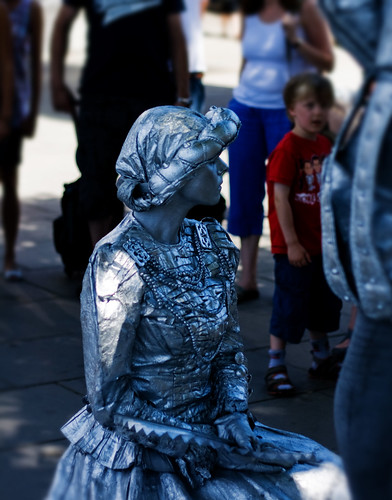
All photo prompts are my own photography - you can find more of it on Flickr. You can also buy my prints from Deviantart. 20% of all proceeds go to charity - the other 80% go towards my PhD fees!
If you want to use the prompt, all I ask is that you include a link to this entry and a credit to me for the photograph, and that you post a link to your story in the comments box below so I can see what you've come up with! If you don't comment on this entry, then I can't comment on your story.
The 59th prompt is Living Statue.
All photo prompts are my own photography - you can find more of it on Flickr. You can also buy my prints from Deviantart. 20% of all proceeds go to charity - the other 80% go towards my PhD fees!
Friday, 11 November 2011
Friday Flash - Remembrance
Tweet
 "Gran? Gran, are you up here?" Sara poked her head around the door.
"Yes, dear. By the window."
Sara pushed the door open and stepped into the attic. Dust motes swirled in the pale sunlight cutting across the floor from the small window in the sloped roof. Her grandmother sat hunched in a battered old armchair, a mug of tea in one hand and a sheaf of papers in the other.
"What are you doing up here by yourself?" asked Sara. Moving between the teetering piles of junk, she spotted an open shoebox beside the chair. Old photographs and scraps of paper, yellow with age, spilled onto the floor.
"The same thing I do every year on 11 November. Say, do you remember when your granddad died, and I had to move in here? I brought all of those old boxes?" asked her grandmother.
"Yeah – Dad wanted to chuck them but you wouldn't let him."
"No, I wouldn't. These are very special, Sara. I got these from my mother just before she died in '73. They belonged to your great-great-grandmother." Sara's grandmother held out the square of paper. Sara took it and turned it over. Spidery handwriting in faded ink covered the paper. She held it up to the light and squinted.
"I can't read it properly."
"Of course you can't. I'm surprised you kids even know how to do proper handwriting any more." Sara's grandmother pursed her lips.
"We use computers now.”
“Yes, and what will you have to show for it? You can’t keep emails in a box, or treasure your tweet thingies forever.”
“So who was she writing to?" asked Sara, keen to avoid another of her grandmother’s Luddite lectures. To make a point, she peered down at the handwriting. She thought she could make out the date. Nineteen-something?
"That one's actually by your great-great-grandfather, Harry Robson. He wrote that one on 8 November 1917. Two days after the end of the Battle of Passchendaele."
"Where's that?"
"Good God, girl, what do they teach you in school these days? It was also known as the Third Battle of Ypres."
"He was in the army? Wow, that's the First World War, isn't it? I didn't know we had any soldiers in the family." Sara stared at the letter, her mouth hanging open with awe.
"We don't. Harry was a stretcher bearer. Poor man had to run out into No Man's Land to collect the wounded. I don't like to even imagine the horrors he saw. He certainly didn't tell my grandmother about them."
"Have you got a photo of him?"
Sara's grandmother flicked through the photographs in her hand. She held out a small snapshot, the scratched sepia and torn edges trembling between her fingers. Sara looked at the proud young man in the photo, his arm around a smiling young woman. A small boy played with a ball at their feet. The young man had the same eyes as her grandmother.
“The little boy is your great-grandfather, Jack. That was taken just before Harry left for the front in 1917 so Jack must have been about six.”
“Why do you look at these every year?”
Sara’s grandmother held up a crumpled letter. She smoothed the paper against her knee and cleared her throat.
“11 September 1918. My dearest Florence, I do not have long, but I could not rest another day without writing a reply to your last letter. Not a day goes by when I do not think about you, and how you are coping without me. At least you have little Jack for company until I return.
“As to the men and myself, we have had many successes this week, but also many losses. I fear each day that I shall lose my humanity, and cease to be moved by the plight of those I bear on my stretcher, but each day I remember to thank them for their sacrifice. I do not envy them their task, although I am sure they do not envy me mine. Can you believe that I have done this for a year?
"However, I have extra reason to thank them, for it is their bravery that keeps our dear little England free. Free for you, and for Jack. It is thoughts of you both that keeps me going, and I am sure it will not be long before I am back with you both. Until then, my love to you both, as always. Yours eternally, H.”
“That’s really nice,” said Sara. She thought of the boys in her class at school, and the crude graffiti that covered their notebooks. She couldn’t imagine any of them penning such a letter.
“It is. This is why I look at these every year. Everyone remembers the fallen, and pays their respects, but I like to remember who and what we lost in my own way.”
“Who we lost?”
“Harry wrote that in a rare break during the Allied Hundred Days Offensive. A week later, he was killed by shrapnel. He, like so many others, never came home,” replied her grandmother. The old woman fixed Sara with a stare. “So just you remember that.”

"Yes, dear. By the window."
Sara pushed the door open and stepped into the attic. Dust motes swirled in the pale sunlight cutting across the floor from the small window in the sloped roof. Her grandmother sat hunched in a battered old armchair, a mug of tea in one hand and a sheaf of papers in the other.
"What are you doing up here by yourself?" asked Sara. Moving between the teetering piles of junk, she spotted an open shoebox beside the chair. Old photographs and scraps of paper, yellow with age, spilled onto the floor.
"The same thing I do every year on 11 November. Say, do you remember when your granddad died, and I had to move in here? I brought all of those old boxes?" asked her grandmother.
"Yeah – Dad wanted to chuck them but you wouldn't let him."
"No, I wouldn't. These are very special, Sara. I got these from my mother just before she died in '73. They belonged to your great-great-grandmother." Sara's grandmother held out the square of paper. Sara took it and turned it over. Spidery handwriting in faded ink covered the paper. She held it up to the light and squinted.
"I can't read it properly."
"Of course you can't. I'm surprised you kids even know how to do proper handwriting any more." Sara's grandmother pursed her lips.
"We use computers now.”
“Yes, and what will you have to show for it? You can’t keep emails in a box, or treasure your tweet thingies forever.”
“So who was she writing to?" asked Sara, keen to avoid another of her grandmother’s Luddite lectures. To make a point, she peered down at the handwriting. She thought she could make out the date. Nineteen-something?
"That one's actually by your great-great-grandfather, Harry Robson. He wrote that one on 8 November 1917. Two days after the end of the Battle of Passchendaele."
"Where's that?"
"Good God, girl, what do they teach you in school these days? It was also known as the Third Battle of Ypres."
"He was in the army? Wow, that's the First World War, isn't it? I didn't know we had any soldiers in the family." Sara stared at the letter, her mouth hanging open with awe.
"We don't. Harry was a stretcher bearer. Poor man had to run out into No Man's Land to collect the wounded. I don't like to even imagine the horrors he saw. He certainly didn't tell my grandmother about them."
"Have you got a photo of him?"
Sara's grandmother flicked through the photographs in her hand. She held out a small snapshot, the scratched sepia and torn edges trembling between her fingers. Sara looked at the proud young man in the photo, his arm around a smiling young woman. A small boy played with a ball at their feet. The young man had the same eyes as her grandmother.
“The little boy is your great-grandfather, Jack. That was taken just before Harry left for the front in 1917 so Jack must have been about six.”
“Why do you look at these every year?”
Sara’s grandmother held up a crumpled letter. She smoothed the paper against her knee and cleared her throat.
“11 September 1918. My dearest Florence, I do not have long, but I could not rest another day without writing a reply to your last letter. Not a day goes by when I do not think about you, and how you are coping without me. At least you have little Jack for company until I return.
“As to the men and myself, we have had many successes this week, but also many losses. I fear each day that I shall lose my humanity, and cease to be moved by the plight of those I bear on my stretcher, but each day I remember to thank them for their sacrifice. I do not envy them their task, although I am sure they do not envy me mine. Can you believe that I have done this for a year?
"However, I have extra reason to thank them, for it is their bravery that keeps our dear little England free. Free for you, and for Jack. It is thoughts of you both that keeps me going, and I am sure it will not be long before I am back with you both. Until then, my love to you both, as always. Yours eternally, H.”
“That’s really nice,” said Sara. She thought of the boys in her class at school, and the crude graffiti that covered their notebooks. She couldn’t imagine any of them penning such a letter.
“It is. This is why I look at these every year. Everyone remembers the fallen, and pays their respects, but I like to remember who and what we lost in my own way.”
“Who we lost?”
“Harry wrote that in a rare break during the Allied Hundred Days Offensive. A week later, he was killed by shrapnel. He, like so many others, never came home,” replied her grandmother. The old woman fixed Sara with a stare. “So just you remember that.”
Wednesday, 9 November 2011
[Review] Shadow of a Dead Star
Tweet
 I first encountered Michael Shean on Twitter, and after several jolly conversations, decided that I'd check out his blog. I did so, to discover he had a book for sale (this is why you should engage me in conversation - it makes me much more interested in what you're actually working on). Shadow of a Dead Star is the first book in his Wonderland cycle, in a genre I can only describe as cyberpunk sci-fi noir.
Set in Seattle in 2078, Shadow of a Dead Star follows Industrial Security Bureau agent Thomas Walken. Walken is the grizzled, cynical hero who fights to keep black-market technology from making its way into the mainstream. When he intercepts a smuggled shipment of little girls hardwired as sex toys, he finds himself tumbling down the rabbit hole into a nightmarish world of synthetic humans, hard-talking hackers and the kind of technology you thought only existed in Blade Runner.
Surrounded by conspiracies and caught on the run between three sectors of Seattle, each as brutal as the other but in completely different ways, Walken's resolve, abilities and strength are severely tested. He's not entirely on his own as his world crumbles around him - fate sends him Bobbi, a sparky young hacker with a sharp tongue and impressive tech skills. Question is, can Walken and Bobbi get to the bottom of the madness before a termination order is put on the Agent?
Science fiction is a genre I enjoy watching at the cinema but it's not usually a genre that I'd read. Luckily for me, Shadow of a Dead Star reads more like a gritty noir that just happens to feature cool technology and sci-fi ideas. It's testament to Shean's skill that everything seems completely plausible - and that I stayed up way too late to finish it, deciding I couldn't possibly put it down and pick it up the following day. It's an engaging read, full of complex characters, and bursting with invention. Whether you like sci fi, noir or cyberpunk, I'd highly recommend it.
NOTE: I've removed the Buy links since the book will be re-published later in the year by Michael's new publisher! In the meantime, Michael is also running a new serial over on Curiosity Quills. The first instalment is here!

Set in Seattle in 2078, Shadow of a Dead Star follows Industrial Security Bureau agent Thomas Walken. Walken is the grizzled, cynical hero who fights to keep black-market technology from making its way into the mainstream. When he intercepts a smuggled shipment of little girls hardwired as sex toys, he finds himself tumbling down the rabbit hole into a nightmarish world of synthetic humans, hard-talking hackers and the kind of technology you thought only existed in Blade Runner.
Surrounded by conspiracies and caught on the run between three sectors of Seattle, each as brutal as the other but in completely different ways, Walken's resolve, abilities and strength are severely tested. He's not entirely on his own as his world crumbles around him - fate sends him Bobbi, a sparky young hacker with a sharp tongue and impressive tech skills. Question is, can Walken and Bobbi get to the bottom of the madness before a termination order is put on the Agent?
Science fiction is a genre I enjoy watching at the cinema but it's not usually a genre that I'd read. Luckily for me, Shadow of a Dead Star reads more like a gritty noir that just happens to feature cool technology and sci-fi ideas. It's testament to Shean's skill that everything seems completely plausible - and that I stayed up way too late to finish it, deciding I couldn't possibly put it down and pick it up the following day. It's an engaging read, full of complex characters, and bursting with invention. Whether you like sci fi, noir or cyberpunk, I'd highly recommend it.
NOTE: I've removed the Buy links since the book will be re-published later in the year by Michael's new publisher! In the meantime, Michael is also running a new serial over on Curiosity Quills. The first instalment is here!
Monday, 7 November 2011
Photo Prompt 58
Tweet
New prompt available!
If you want to use the prompt, all I ask is that you include a link to this entry and a credit to me for the photograph, and that you post a link to your story in the comments box below so I can see what you've come up with! If you don't comment on this entry, then I can't comment on your story.
The 58th prompt is Robin.
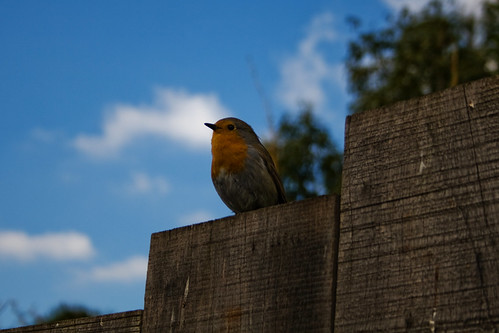
All photo prompts are my own photography - you can find more of it on Flickr. You can also buy my prints from Deviantart. 20% of all proceeds go to charity - the other 80% go towards my PhD fees!
If you want to use the prompt, all I ask is that you include a link to this entry and a credit to me for the photograph, and that you post a link to your story in the comments box below so I can see what you've come up with! If you don't comment on this entry, then I can't comment on your story.
The 58th prompt is Robin.
All photo prompts are my own photography - you can find more of it on Flickr. You can also buy my prints from Deviantart. 20% of all proceeds go to charity - the other 80% go towards my PhD fees!


 Posts
Posts


