Friday, 23 April 2010
Friday Flash - The Dead Do Listen
Tweet
You can now find this flash in its new home at Everyday Weirdness!


Wednesday, 21 April 2010

Tuesday, 20 April 2010
Progress on my serial
Tweet
 Friday will be the tenth week that I will be hitting 'Publish' on my web serial, Tales from Vertigo City. In honour of that, I thought I might write a blog entry about the serial, to hopefully explain more about it.
The idea behind the serial was to write a series of tales, all set in the fictional city of Vertigo. In my head, the city looks like a cross between a 1940s Art Deco metropolis and Victorian London. People travel by tram or hackney carriage, although tradespeople prefer to use a cart. There is even a neighbourhood for the Living Dead, who are essentially the former upper middle class who refuse to relinquish their status, even after death. I suppose I'm going for a twist on the steampunk theme.
The current run of installments are part of The First Tale. The idea for this came from a short flash I wrote about an antique generator that powered a Resistance movement. People wanted to know more, so I decided to write a serial, updated weekly.
So far in the story, Philip Wiseman has been grudgingly accepted into the movement after a stranger infiltrated the sewers and underground tunnels that make up the Resistance territory beneath the sprawling city. After being accused of being a spy, and surviving a close encounter with a bloodthirsty beast, Philip ends up back on the streets. This time he accompanies Commander Melissa Hunt (or Liss for short) to try and discover who the stranger was, and why he was in the Resistance tunnels.
I'm really enjoying writing it, but I admit that it's very much 'seat of the pants' writing. I only have the plot in mind for the next two or three installments at a time. What happens is as much as surprise as it is to readers! I consider the serial to be something of an experiment, but hopefully an enjoyable one. People often complain that they don't have enough time to read, and short stories published online are often too long to take in during one sitting, so I'm hoping that The First Tale's episodic nature, and the brief nature of these episodes, makes it an enjoyable read.
It's also good for me since having a deadline gives me the motivation to write every week, so even if I write nothing else, I've at least continued the story and built a little more of Vertigo City. It also gives me a place to use those small elements or images that pop into my head, but aren't big enough to sustain a story on their own. Who knows, maybe those small elements that I plant now will go on to become major tales in their own right?

The idea behind the serial was to write a series of tales, all set in the fictional city of Vertigo. In my head, the city looks like a cross between a 1940s Art Deco metropolis and Victorian London. People travel by tram or hackney carriage, although tradespeople prefer to use a cart. There is even a neighbourhood for the Living Dead, who are essentially the former upper middle class who refuse to relinquish their status, even after death. I suppose I'm going for a twist on the steampunk theme.
The current run of installments are part of The First Tale. The idea for this came from a short flash I wrote about an antique generator that powered a Resistance movement. People wanted to know more, so I decided to write a serial, updated weekly.
So far in the story, Philip Wiseman has been grudgingly accepted into the movement after a stranger infiltrated the sewers and underground tunnels that make up the Resistance territory beneath the sprawling city. After being accused of being a spy, and surviving a close encounter with a bloodthirsty beast, Philip ends up back on the streets. This time he accompanies Commander Melissa Hunt (or Liss for short) to try and discover who the stranger was, and why he was in the Resistance tunnels.
I'm really enjoying writing it, but I admit that it's very much 'seat of the pants' writing. I only have the plot in mind for the next two or three installments at a time. What happens is as much as surprise as it is to readers! I consider the serial to be something of an experiment, but hopefully an enjoyable one. People often complain that they don't have enough time to read, and short stories published online are often too long to take in during one sitting, so I'm hoping that The First Tale's episodic nature, and the brief nature of these episodes, makes it an enjoyable read.
It's also good for me since having a deadline gives me the motivation to write every week, so even if I write nothing else, I've at least continued the story and built a little more of Vertigo City. It also gives me a place to use those small elements or images that pop into my head, but aren't big enough to sustain a story on their own. Who knows, maybe those small elements that I plant now will go on to become major tales in their own right?
Sunday, 18 April 2010
House Plants
Tweet
 I never thought of myself as having green fingers, but after working in an office festooned with pot plants and ferns, I came around the the idea of trying to grow something myself. Basil, rosemary, a grape hyacinth and African violets all lasted a while, but not really knowing what I was doing came to be a bit of a problem. I love the colours and smells of house plants, so I've finally invested in a couple of books about caring for them.
I took myself off to Homebase on Saturday, where I ended up buying a miniature rose (see left). Due to bad associations, I don't like being given roses, but I still think they're one of the prettiest roses in the garden (or, in my case, living room). I chose the peach variety because it looked to be the healthiest in the garden centre, and it's such a cheerful little plant. The Victorians were very keen on the 'language of flowers', encoding messages in the flowers they sent. According to this language, the peach rose represents immortality and modesty.
 I also went for a gardenia. The smell is amazing, which means it's a pleasure to walk in my front door. The gardenia means 'refinement' and 'purity', but I think they're just beautiful looking plants. Apparently they like a lot of natural light, but not direct sunlight, so my gardenia now sits on my writing table. I'm hoping it provides some form of inspiration or creative stimulus when I sit down to scribble.
 My third choice of the day turned out to be an Easter cactus. My mum has had the Christmas variety for years, and as my windowsills get a lot of daylight, so I figured I'd give the Easter variety a go. As the name implies, they flower between January and April. They need both a rest period, and time outdoors in the shade, to ensure they flower again, and they have such pretty flowers that I'm hoping I can entice mine to do exactly that. Cacti of all kinds represent endurance, which is quite apt considering I'm hoping to apply that to my writing career, so here's to hoping my cactus makes itself at home and goes from strength to strength.
 My final plant is slightly older, by a fortnight or so. I bought a gerbera, of the daisy family, in Tesco (of all places) and since repotting it, it has gone from strength to strength! It's a beautiful, cheerful little flower, and represents innocence. The petals have also changed colour - they were dark orange when I first bought it, and now they've turned a deep pink colour.
I'm hoping that I manage to keep them all alive, because they really do improve the atmosphere of my flat. That's my home, and also where I do most of my writing, and anything that improves the environment has got to be a good thing.
What, if anything, have you done to boost your creative space?

I took myself off to Homebase on Saturday, where I ended up buying a miniature rose (see left). Due to bad associations, I don't like being given roses, but I still think they're one of the prettiest roses in the garden (or, in my case, living room). I chose the peach variety because it looked to be the healthiest in the garden centre, and it's such a cheerful little plant. The Victorians were very keen on the 'language of flowers', encoding messages in the flowers they sent. According to this language, the peach rose represents immortality and modesty.


I'm hoping that I manage to keep them all alive, because they really do improve the atmosphere of my flat. That's my home, and also where I do most of my writing, and anything that improves the environment has got to be a good thing.
What, if anything, have you done to boost your creative space?
Friday, 16 April 2010
Fiction Friday #7
Tweet
Here's my attempt for this week's Fiction Friday challenge on the Write Anything blog, also submitted to the Friday Flash collection. The prompt was;
While digging in a cereal box for the toy surprise, a child makes a grisly discovery.
"Must you go rooting through the box like that, Tim?"
Annie pursed her lips as her son plunged his arm deeper into the cereal box. His hand crunched around in the cornflakes, his fist flexing as his fingers scrabbled for the toy.
"I can't wait, Mum! It might take us forever to get to the bottom of the box, and then I'd be dead, and I'd never have the toy and some robot boy would be playing with Batman and not me."
"Yes, dear, but the rest of us might want to eat those cornflakes that you're smashing. Did you at least wash your hands first?"
"Yes, Mum. I used soap and everything."
Tim stuck out his tongue in concentration as he continued to fish. Annie shook her head and turned back to the washing up. She could never understand why the companies insisted on putting the freebies inside the bag with the cereal. It would be so much easier to put them in between the bag and the box. These companies were clearly run by people without children.
The sound of the box hitting the table and cornflakes skittering across the floor made Annie jump. She turned around to scold Tim. He sat at the table, clutching something in each hand. Sheer joy shined in his eyes.
"Wow! Look, Mum! I got two toys! I got the Batman toy, and this!"
Tim held up a severed finger. Blood clotted around the stump, and she could see dried mud caked under the nail. It still wore a tarnished silver ring. Annie's stomach rolled.
"Tim, I think you'd better put that down." She clutched the bench, forcing herself not to gag.
"No way! This is brilliant!"
Tim launched himself from his chair and clattered out of the kitchen. The discarded Batman figure lay on the table, surrounded by cornflake crumbs. Annie snatched up the box, searching for the complaints phone number. She hoped they would at least get a free box of cornflakes, or at least a reward for returning the ring.
Wednesday, 14 April 2010
How to use smell when writing scenes
Tweet
 I found a rather useful entry about composing scenes on the Write It Sideways blog, and it got me thinking. Scenes are incredibly important to fiction, as they tell us about location and setting, introduce us to characters, and move the plot along. Think about cinema - everyone can always think of favourite scenes. One of mine is from The 39 Steps (1935). The fugitive Richard Hannay (Robert Donat) is handcuffed to the glacial blonde Pamela (Madeleine Carroll), and they're forced to spend a night together in an inn. Our hapless pair may not belong in their surroundings (rural Scotland), but they certainly belong with each other.
Another favourite scene is in Watchmen - Nite Owl and the Silk Spectre have gone to bust Rorschach out of prison, and when they find him, he excuses himself to go to the bathroom. The swinging door allows us to see him advance towards a cowering Big Figure, but we can only guess what Rorschach does after he leaves the bathroom and blood begins to flow beneath the door. We've already seen how resourceful Rorschach is when it comes to weapons, and leaving this to the imagination is a masterstroke.
So scenes are crucial - you can't really have a piece of storytelling, in any form, without one. If you're writing a scene based on something that happened to you, then answering the questions in the Write It Sideways list should be easy. You've got a point of reference to work to. However, if you're inventing the scene, then you need to work a bit harder at making it feel as real for your readers as it does inside your head. Clearly there is something to be said for the age-old maxim of "less is more", but you can easily create the scene using sparse, but vital, details.
It is at this point that I want to highlight points 14, and 15, regarding smell. Using smell, you can quickly and easily evoke a whole host of emotions, as well as locales, and you can do so in a way that is different, and original. Human beings might rely heavily on visuals, but your problem with describing how a scene looks is that a lot of readers want basic details, so their imagination can sketch in the rest. Using sounds can help, but smell activates a different part of the brain, one located near the memory centre. Sure, you can't exactly introduce scratch-n-sniff to your work, but by describing smells well, your reader can know exactly what kind of scene has been set up without you having to force-feed them visual details.
For example; if you describe a rotting/musty smell, or a 'stench', people aren't going to visualise a sunny breakfast room filled with flowers, are they? Yet too many flowers (particularly certain kinds of lillies) can end up making even the most pretty room seem a tad funereal. Unpleasant smells in an otherwise nice setting lend an air of menace, while particular smells can let you hint at the time of the day, or time of year, without you having to spell it out. Or should that be 'smell it out'?
When writing scenes, how often do you include smell?

Another favourite scene is in Watchmen - Nite Owl and the Silk Spectre have gone to bust Rorschach out of prison, and when they find him, he excuses himself to go to the bathroom. The swinging door allows us to see him advance towards a cowering Big Figure, but we can only guess what Rorschach does after he leaves the bathroom and blood begins to flow beneath the door. We've already seen how resourceful Rorschach is when it comes to weapons, and leaving this to the imagination is a masterstroke.
So scenes are crucial - you can't really have a piece of storytelling, in any form, without one. If you're writing a scene based on something that happened to you, then answering the questions in the Write It Sideways list should be easy. You've got a point of reference to work to. However, if you're inventing the scene, then you need to work a bit harder at making it feel as real for your readers as it does inside your head. Clearly there is something to be said for the age-old maxim of "less is more", but you can easily create the scene using sparse, but vital, details.
It is at this point that I want to highlight points 14, and 15, regarding smell. Using smell, you can quickly and easily evoke a whole host of emotions, as well as locales, and you can do so in a way that is different, and original. Human beings might rely heavily on visuals, but your problem with describing how a scene looks is that a lot of readers want basic details, so their imagination can sketch in the rest. Using sounds can help, but smell activates a different part of the brain, one located near the memory centre. Sure, you can't exactly introduce scratch-n-sniff to your work, but by describing smells well, your reader can know exactly what kind of scene has been set up without you having to force-feed them visual details.
For example; if you describe a rotting/musty smell, or a 'stench', people aren't going to visualise a sunny breakfast room filled with flowers, are they? Yet too many flowers (particularly certain kinds of lillies) can end up making even the most pretty room seem a tad funereal. Unpleasant smells in an otherwise nice setting lend an air of menace, while particular smells can let you hint at the time of the day, or time of year, without you having to spell it out. Or should that be 'smell it out'?
When writing scenes, how often do you include smell?
Monday, 12 April 2010
The Cinema of Spectacle - Or Pure Escapism
Tweet
 I went to see Clash of the Titans on Saturday night, and I'm pleased to tell you that I actually really enjoyed it. Sure, it's hardly Hamlet in terms of dialogue, and Sam Worthington proves yet again that his acting talents don't stretch far beyond "thug with a heart" (but he's so watchable, I'll forgive him for the time being), but it's just fun to watch. Besides, every so often Ralph Fiennes and Liam Neeson pop up to truly ham it up as Greek gods. What more could you want from a film?
The thing is, as a former film student, I know that films like this are often looked down on as being trash or simply not worth the study. I can't begin to describe how much this annoys me, because it is so incredibly reductivist to assume that only 'serious' or 'weighty' films that put social commentary or aesthetic value above plot are worth looking at. I managed to write university essays on Attack of the 50ft Woman as a feminist text, Deep Red as a gender study, and the use of narrative in The Lion King, for God's sake! Right there, you have a 1950s B-movie, a 1970s Italian slasher and a Disney cartoon up for discussion. I even did my undergrad dissertation on a comparison between Hitchcock's representation of the serial killer, and that of contemporary cinema. My point is, you can find something of worth in such a broad range of films, and I think even the Academy are beginning to be swayed on this point (Pixar winning Oscars, Avatar being nominated, etc.)
When cinema first began to capture the public's imagination, it very soon split into two branches. The Lumière brothers focussed on narrative cinema, showing the awestruck public, what to our eyes is incredibly mundane, footage of real life. This trend can be seen surfacing again in Italy (Italian Neo Realism), France (the New Wave) and also Britain (the so-called 'kitchen sink' dramas of the 1950s). While these movements didn't report the truth, they did ground their films in reality, focussing on everyday issues and often casting real people instead of actors.
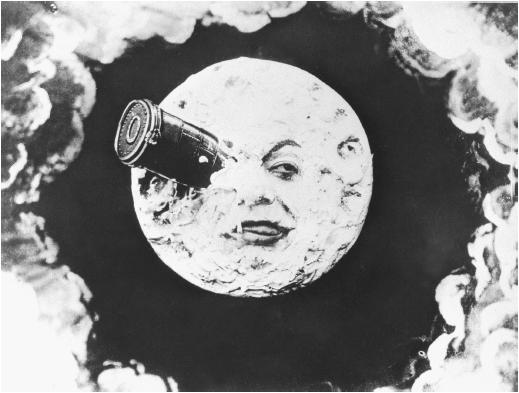
The second branch followed the visionary Georges Méliès, whose often surreal cinematic experiments gave us such iconic images as a train crashing into the moon (see above - from A Trip to the Moon in 1902). He made the use of multiple exposures, dissolves, substitution, time lapse photography and hand-painted films commonplace, and his 'special effects' cinema, or Cinema of Spectacle, has influenced many movements and directors ever since. Indeed, many of the effects in the work of the French Surrealists would not have been possible without Méliès, and his latterday descendants include the likes of Guillermo del Toro, Tim Burton and even Zack Snyder.
The problem is that many people still see the Cinema of Spectacle as being a purely visual experience, and therefore assume that narrative cinema is somehow the more intelligent or sophisticated of the two. The reasoning appears to run that anyone can make a pretty film (stand up, Tim Burton) but not everyone can make a film "with something to say". (Although, as I've stated before, sci-fi can tell us more about the world in which we live than any four-hour long Oscar contender that no doubt tackled 'difficult issues' or depressed the three people that actually went to see it.) I would argue that as real life grows increasingly bleak and depressing, we need the Cinema of Spectacle more than ever. It's little wonder that the fantasy genres do better during times of economic hardship (witness the sudden boom in sci-fi last year, during the world's economic downturn) since people don't want to be reminded of the crushing reality of their mundane little existence.
Call me a Philistine if you want, but I vote for escapism every time.
The thing is, as a former film student, I know that films like this are often looked down on as being trash or simply not worth the study. I can't begin to describe how much this annoys me, because it is so incredibly reductivist to assume that only 'serious' or 'weighty' films that put social commentary or aesthetic value above plot are worth looking at. I managed to write university essays on Attack of the 50ft Woman as a feminist text, Deep Red as a gender study, and the use of narrative in The Lion King, for God's sake! Right there, you have a 1950s B-movie, a 1970s Italian slasher and a Disney cartoon up for discussion. I even did my undergrad dissertation on a comparison between Hitchcock's representation of the serial killer, and that of contemporary cinema. My point is, you can find something of worth in such a broad range of films, and I think even the Academy are beginning to be swayed on this point (Pixar winning Oscars, Avatar being nominated, etc.)
When cinema first began to capture the public's imagination, it very soon split into two branches. The Lumière brothers focussed on narrative cinema, showing the awestruck public, what to our eyes is incredibly mundane, footage of real life. This trend can be seen surfacing again in Italy (Italian Neo Realism), France (the New Wave) and also Britain (the so-called 'kitchen sink' dramas of the 1950s). While these movements didn't report the truth, they did ground their films in reality, focussing on everyday issues and often casting real people instead of actors.
The second branch followed the visionary Georges Méliès, whose often surreal cinematic experiments gave us such iconic images as a train crashing into the moon (see above - from A Trip to the Moon in 1902). He made the use of multiple exposures, dissolves, substitution, time lapse photography and hand-painted films commonplace, and his 'special effects' cinema, or Cinema of Spectacle, has influenced many movements and directors ever since. Indeed, many of the effects in the work of the French Surrealists would not have been possible without Méliès, and his latterday descendants include the likes of Guillermo del Toro, Tim Burton and even Zack Snyder.
The problem is that many people still see the Cinema of Spectacle as being a purely visual experience, and therefore assume that narrative cinema is somehow the more intelligent or sophisticated of the two. The reasoning appears to run that anyone can make a pretty film (stand up, Tim Burton) but not everyone can make a film "with something to say". (Although, as I've stated before, sci-fi can tell us more about the world in which we live than any four-hour long Oscar contender that no doubt tackled 'difficult issues' or depressed the three people that actually went to see it.) I would argue that as real life grows increasingly bleak and depressing, we need the Cinema of Spectacle more than ever. It's little wonder that the fantasy genres do better during times of economic hardship (witness the sudden boom in sci-fi last year, during the world's economic downturn) since people don't want to be reminded of the crushing reality of their mundane little existence.
Call me a Philistine if you want, but I vote for escapism every time.



 Posts
Posts


